Businesses today depend on laptops, servers, cloud applications, email, networks, and identity systems to keep their operations moving. As these environments become more connected, businesses also need better visibility into what is happening across their technology infrastructure.
This is where EDR, XDR, and MDR become important.
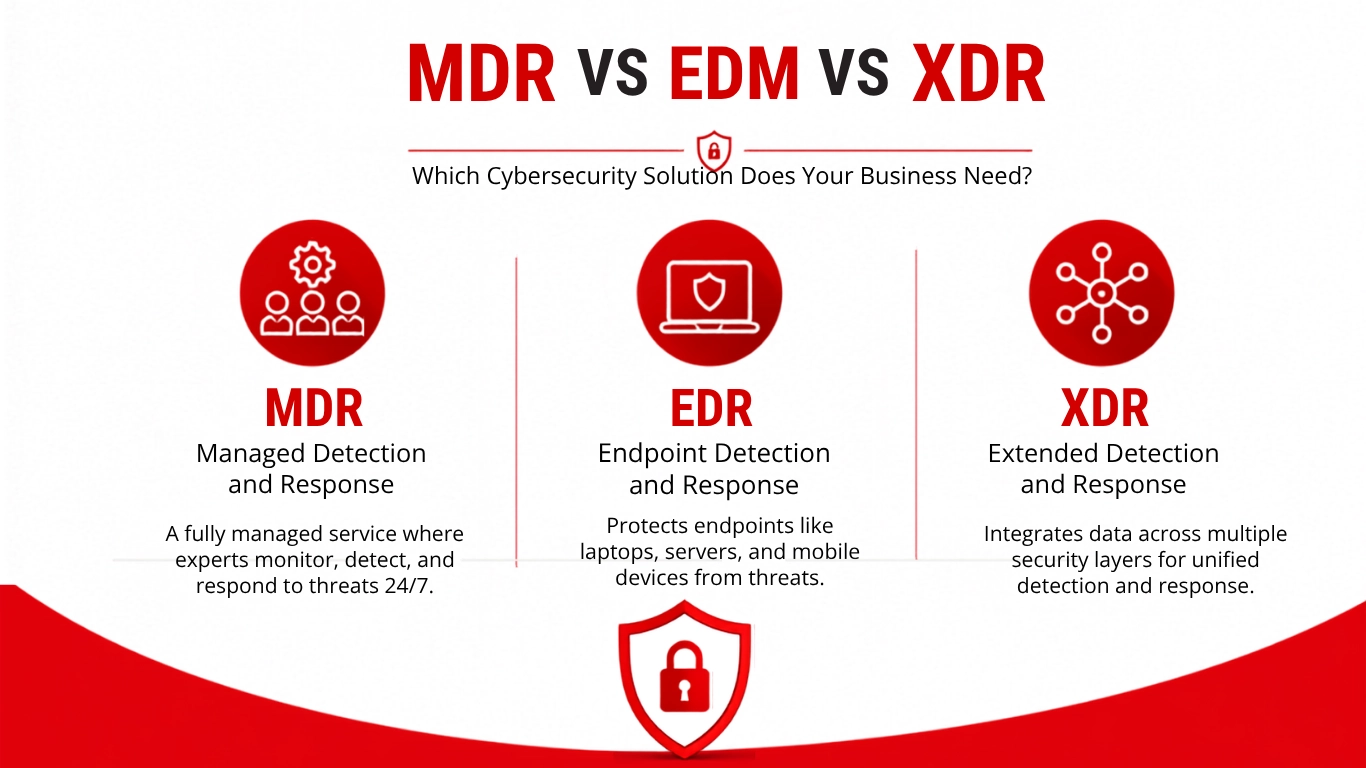
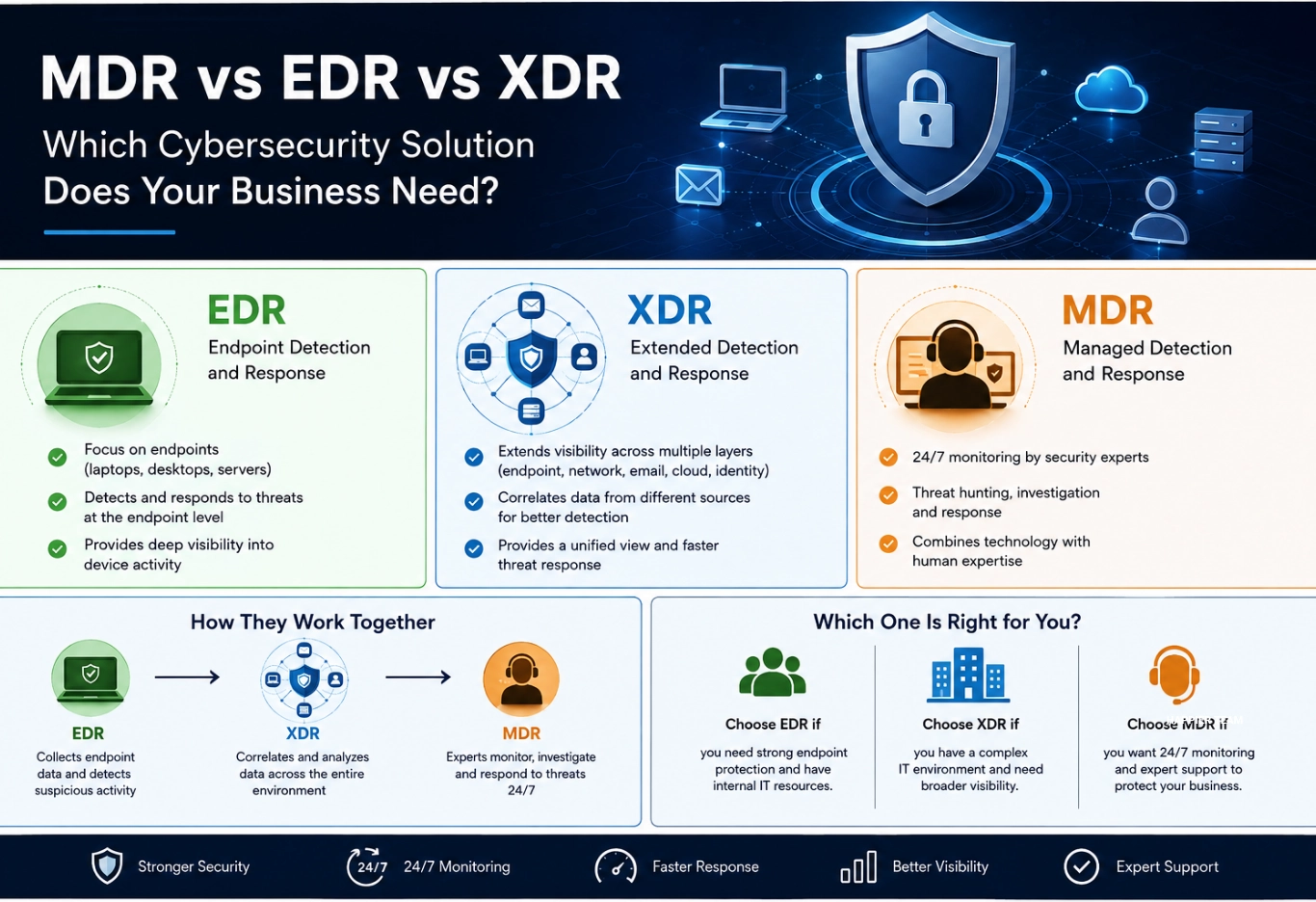
These three terms are often discussed together, but they describe different parts of a cybersecurity strategy. EDR focuses mainly on endpoint devices, XDR connects security information across multiple layers, while MDR adds a managed team of security professionals to monitor, investigate, and support response activities.
Understanding the difference between MDR vs EDR vs XDR can help businesses choose a security approach that fits their IT environment, internal expertise, and operational needs.
What Is EDR?
EDR stands for Endpoint Detection and Response.
EDR is a cybersecurity technology designed to monitor and protect endpoint devices. These can include laptops, desktops, workstations, and servers.
Rather than relying only on traditional antivirus detection, EDR collects information about activity on endpoints and helps security teams investigate unusual behavior. Depending on the platform, it can provide visibility into processes, files, connections, and other endpoint events.
The main strength of EDR is detailed endpoint visibility.
For example, a company with employees working on many laptops can use EDR to monitor those devices from a central security platform. If suspicious activity appears on one endpoint, the security team can investigate what happened and take appropriate action.
What Can EDR Help With?
EDR can support activities such as:
EDR is especially useful for organizations that already have internal IT or security professionals who can review alerts and manage the platform.
It can also provide important data to broader security platforms, including XDR environments.
What Is XDR?
XDR stands for Extended Detection and Response.
XDR extends security visibility beyond individual endpoints. It can bring together security signals from different areas of an organization, such as endpoints, email, identity, networks, cloud applications, and other security tools.
The purpose is to give security teams a more connected view of security events.
Consider a simple example. A suspicious email is received by an employee. A few minutes later, a login event occurs from an unusual location, followed by unusual activity on the employee’s device.
When these signals are viewed separately, they may not provide enough context. XDR is designed to connect information from different security layers so analysts can see the broader picture.
Why Businesses Use XDR
XDR can be useful for organizations that have more complex IT environments and want centralized visibility.
Its potential benefits include the following:
XDR does not necessarily replace EDR. In many environments, endpoint telemetry is one of the important sources used by an XDR platform.
What Is MDR?
MDR stands for Managed Detection and Response.
The biggest difference between MDR and EDR/XDR is the delivery model.
EDR and XDR are technologies or platforms. MDR is a managed cybersecurity service that combines security technologies with human expertise.
An MDR provider can monitor security events, investigate suspicious activity, perform threat hunting, prioritize incidents, and guide or perform response actions depending on the service scope. Many MDR services operate through security operations teams and provide continuous monitoring.
MDR can use technologies such as EDR, XDR, SIEM, threat intelligence, and other security tools as part of its service.
Why Businesses Consider MDR
Many organizations have internal IT teams but do not have enough dedicated security resources to continuously monitor and investigate alerts.
MDR can extend those internal capabilities by providing access to security analysts and specialist expertise. Microsoft, for example, describes its MDR offering as a service that can augment existing SOC teams and help reduce their workload.
This makes MDR useful for businesses that want professional security monitoring without building a complete security operations function internally.
MDR vs EDR vs XDR: The Key Difference
EDR vs XDR: Which One Should You Choose?
When comparing EDR vs XDR, the right choice depends on the business environment.
EDR can be a strong fit when endpoint monitoring is the main priority and the organization has internal professionals who can manage alerts and investigations.
XDR may be more suitable when a business has a wider technology environment and wants security visibility across endpoints, identity, email, networks, cloud applications, or other tools.
An important point is that EDR and XDR are not always competing choices. EDR can form part of an XDR strategy, providing endpoint data that is then correlated with other security signals.
For example, a business may use endpoint protection on employee laptops while also using an XDR platform to connect endpoint, email, identity, and cloud information.
MDR vs EDR: What Is the Difference?
The main difference in MDR vs EDR is technology versus service.
EDR provides software and endpoint security capabilities. The organization is responsible for monitoring and managing the platform unless another service provider is involved.
MDR provides a managed service that combines technology with security professionals who review security events and support detection, investigation, and response.
An MDR provider may use EDR as one part of its security technology stack. This means a business can have the visibility provided by EDR while also gaining access to external security expertise.
MDR vs XDR: How Are They Different?
The difference between MDR vs XDR also comes down to platform versus service.
XDR is designed to connect security signals across multiple sources and provide broader detection and investigation capabilities.
MDR is delivered as a managed service. The provider operates the security monitoring process, investigates relevant incidents, and supports response according to the agreed service scope.
In some environments, MDR services use XDR technology as part of their underlying security architecture.
This means businesses do not necessarily have to choose between XDR and MDR. They can use an XDR platform while also using an MDR provider to support monitoring and security operations.
Which Cybersecurity Solution Is Right for Your Business?
There is no single solution that is automatically right for every organization. The best option depends on the company’s size, infrastructure, internal expertise, security requirements, and preferred operating model.
EDR May Be Suitable When:
XDR May Be Suitable When:
MDR May Be Suitable When:
MDR can also work alongside an existing SOC rather than replacing it. Microsoft currently describes its MDR service as a way to augment SOC teams, reduce workload, and provide additional expert support.
Can EDR, XDR, and MDR Work Together?
Yes. In fact, modern cybersecurity environments often combine several technologies and services.
A business might deploy EDR across employee devices to collect endpoint security data. That information can then be integrated into an XDR platform alongside data from email, identity, network, and cloud systems.
An MDR provider can then monitor the environment, investigate important events, and provide response support.
This creates a layered approach:
The technologies can therefore complement each other instead of being treated as completely separate choices.
What Should You Evaluate Before Choosing?
Before selecting an EDR, XDR, or MDR solution, businesses should first understand their current IT environment.
Start by reviewing the number of endpoints and servers. Then consider your cloud applications, email platforms, identity systems, remote users, network infrastructure, and existing security tools.
You should also consider your internal resources.
Ask these questions:
Integration is another important consideration. Before choosing a solution, businesses should check whether it works with their existing security tools and technology environment.
Scalability should also be considered. As the business adds users, devices, offices, applications, and cloud services, its security architecture should be able to grow with it.
Why Human Expertise Still Matters
Security technology can collect large amounts of data and automate many tasks, but businesses also need skilled professionals to understand important security events and make informed decisions.
MDR is designed around this combination of technology and human expertise. Current MDR offerings can use automation and AI to improve investigation and triage while security analysts review and validate important findings.
This does not mean every business needs a fully outsourced security operation. The right model depends on how much expertise already exists inside the organization.
Some companies may operate EDR internally. Others may use XDR with an internal security team. Another business may use MDR to extend its existing IT or SOC capabilities.
Building a Practical Cybersecurity Strategy
Businesses do not have to implement every cybersecurity technology at once.
A practical approach is to start by understanding the current security environment and identifying the areas where additional visibility or monitoring would provide the most value.
For example, an organization may start with strong endpoint protection, then expand its security visibility as its cloud, network, email, and identity environment grows.
As the organization develops, XDR can help bring multiple security signals together, while MDR can provide additional monitoring and specialist support where required.
This gradual approach allows businesses to improve their security strategy while keeping technology aligned with actual business requirements.
Why Professional Cybersecurity Services Can Help
Selecting and managing cybersecurity technologies requires knowledge of both the technology and the business environment.
Professional cybersecurity services can help businesses review their infrastructure, identify security requirements, select suitable solutions, configure security tools, and establish monitoring and response processes.
For organizations that need additional operational support, managed cybersecurity services can provide ongoing monitoring and access to security expertise.
The goal should be to create a security environment that provides useful visibility, organized response processes, and room for future growth.
Final Thoughts
Understanding MDR vs EDR vs XDR becomes much easier when their roles are separated.
EDR focuses on endpoint devices and provides detailed visibility into endpoint activity.
XDR expands that visibility by connecting security signals across multiple layers such as endpoints, email, identity, networks, and cloud environments.
MDR adds a managed security service with security professionals who monitor, investigate, and support response activities.
The right choice depends on your organization’s IT environment, internal capabilities, security objectives, and preferred operating model.
For businesses evaluating cybersecurity solutions, the best approach is to select technologies and services that match real business requirements and can scale as the organization grows.
Chipin Corp can help businesses evaluate their IT and cybersecurity requirements and identify practical solutions across endpoint security, detection and response, managed cybersecurity, and broader IT infrastructure.
Looking to improve your organization’s cybersecurity strategy? Contact Chipin Corp. to discuss your requirements and explore the right security approach for your business.