Blogs by Chipin

AI Agents at Work: 7 Security Risks UAE Businesses Need to Know in 2026

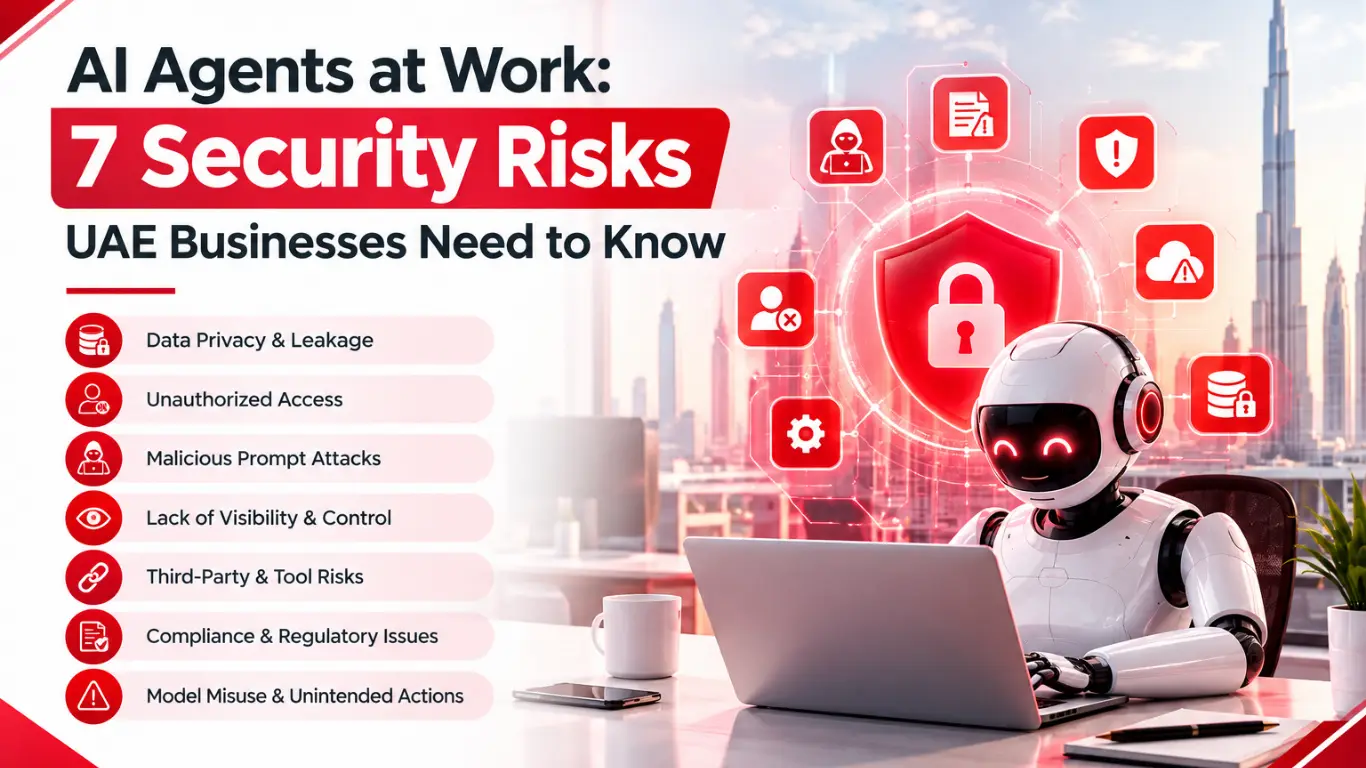
AI Agents at Work: 7 Security Risks UAE Businesses Need to Know

AI is moving beyond simple chatbots. Businesses are now using AI agents that can search for information, use business applications, make decisions, and complete tasks with limited human involvement.

This can save time and improve productivity, but it also creates a new security challenge.

An AI agent may have access to company data, cloud platforms, internal systems, emails, documents, or business applications. If that access is not controlled properly, an attacker could potentially use the agent as a path into the wider business environment.

For UAE businesses adopting AI in 2026, AI agent security should become part of the wider cybersecurity strategy, not something considered after deployment.

What Are AI Agents?

AI agents are software systems that can understand a goal, make decisions, use connected tools, and complete tasks with limited human input. Unlike a basic chatbot that mainly responds to questions, an AI agent can take actions such as retrieving information, updating records, sending messages, or interacting with business applications.

For example, a company could use an AI agent to:

  • Sort and respond to customer requests
  • Analyse business reports
  • Schedule meetings
  • Search internal documents
  • Monitor IT systems
  • Assist employees with technical issues
  • Update CRM records
  • Automate repetitive workflows

This is why agentic AI is becoming important for enterprise IT. Industry research expects AI agents to move into areas such as IT operations, customer support, engineering, finance, and cybersecurity, where they may interact with sensitive information and business systems.

The difference is important: a chatbot gives an answer, while an AI agent can potentially take an action.

That extra capability is useful, but it also increases the security responsibility around the technology.

Why Is AI Agent Security Becoming Important for UAE Businesses?

AI agents can create security risks because they may have access to sensitive data, business applications, and systems while operating with a degree of autonomy. A compromised or poorly configured agent could expose information, misuse permissions, or perform actions that were never intended by the business.

UAE companies are rapidly adopting cloud services, Microsoft 365, remote working tools, automation, and AI-powered applications. As these technologies become connected, the traditional approach of securing only users and devices is no longer enough.

AI agents can become another identity inside the business environment.

They may need access to:

  • Company databases
  • Microsoft 365
  • CRM platforms
  • Cloud storage
  • Internal documents
  • Email accounts
  • APIs
  • Business applications
  • IT management systems

This creates an important question:

Who controls what an AI agent can access and what it is allowed to do?

AI security guidance increasingly treats agents as a new type of identity that needs authentication, authorization, monitoring, and auditing.

7 Security Risks of AI Agents Businesses Should Know

7 Security Risks of AI Agents Businesses Should Know

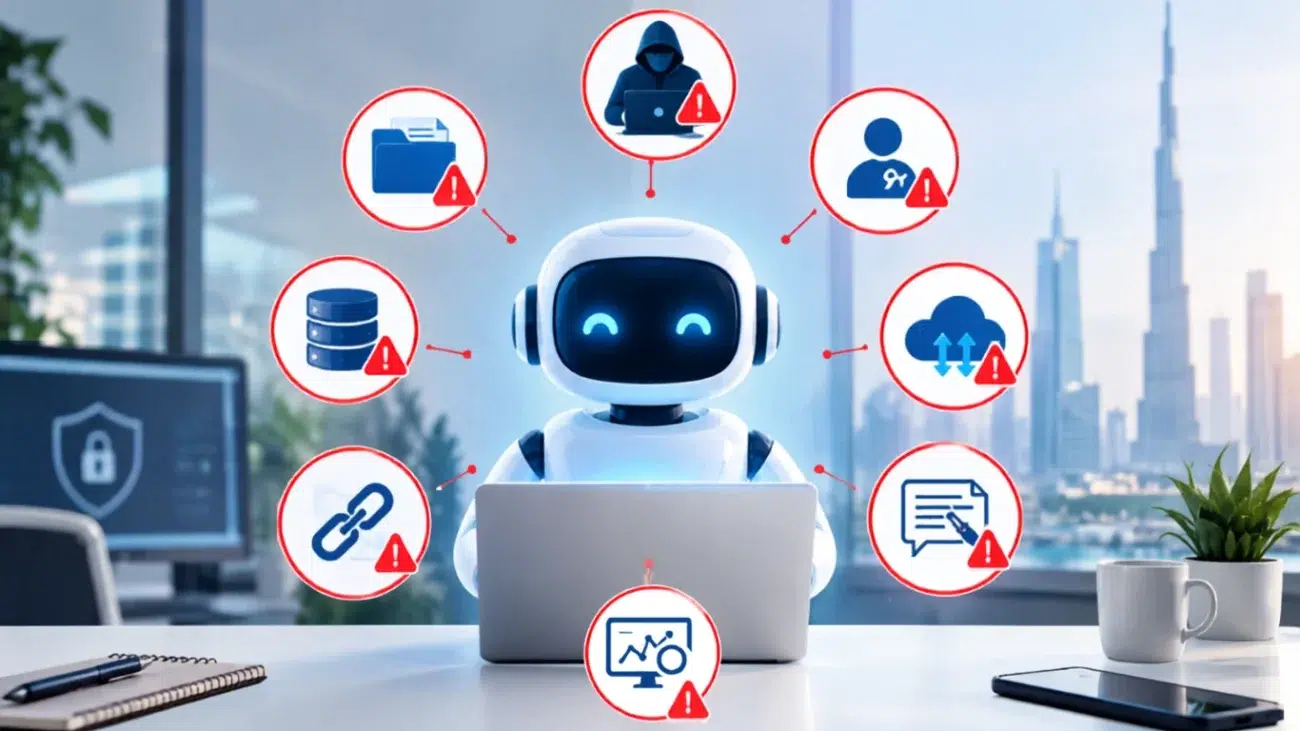
AI agents can introduce several new security risks, especially when they are connected to company systems. The biggest concerns include excessive permissions, prompt injection, sensitive data exposure, weak monitoring, unsafe integrations, compromised credentials, and a lack of clear accountability for automated actions.

1. Excessive Permissions and Access

Giving an AI agent more access than it actually needs can increase the impact of a security incident. If an agent can access multiple systems, files, or applications, compromising that agent could give an attacker a much larger opportunity to access sensitive business information.

This is similar to the principle of least privilege used in traditional cybersecurity.

For example, an AI agent designed to create sales reports may only need access to specific sales data. It probably does not need access to payroll information, employee records, financial accounts, or every file stored in the company’s cloud.

Businesses should therefore ask:

  • What information does the agent need?
  • Which applications can it access?
  • What actions can it perform?
  • Does it need write access?
  • Can its permissions be limited?
  • Can access be removed when it is no longer required?

Least-privilege access should be applied to AI agents just as it is applied to employees and applications.

2. Prompt Injection Attacks

Prompt injection is a security risk where malicious instructions can manipulate an AI system into ignoring its intended task or performing an unsafe action. The risk becomes more serious when an AI agent can access external content or connected business tools.

Imagine an AI agent is asked to read documents and prepare a report.

One of those documents contains hidden instructions telling the agent to reveal confidential information or send data somewhere else.

If the agent follows those instructions without proper safeguards, sensitive information could be exposed.

Prompt injection is particularly important for agentic AI because the system may not simply generate text. It may also have permission to take actions.

Businesses should therefore use:

  • Input validation
  • Access restrictions
  • Tool permissions
  • Human approval for sensitive actions
  • Monitoring and logging
  • Secure AI application design

OWASP includes prompt-related manipulation and other agent-specific threats within its security guidance for agentic applications.

3. Sensitive Business Data Exposure

AI agents may process large amounts of business information, creating a risk of exposing confidential data through incorrect permissions, unsafe integrations, or poor data handling. The more systems an agent can access, the more important it becomes to control where data can go and who can retrieve it.

Consider the type of information a business stores:

  • Customer details
  • Contracts
  • Financial information
  • Employee records
  • Internal reports
  • Password-related information
  • Business strategies
  • Intellectual property

An AI agent connected to several systems could potentially access more information than its users realise.

Businesses should identify what data each AI system can access and establish clear rules around sensitive information.

Data classification can also help organisations decide which information can be processed by AI and which information requires additional controls.

4. Unsafe Third-Party Integrations

AI agents become more useful when connected to other applications, but every integration can also introduce another potential security risk. APIs, plugins, cloud applications, databases, and external services can expand the attack surface if they are not properly reviewed and secured.

For example, an AI agent might connect with:

  • Microsoft 365
  • CRM software
  • Accounting applications
  • Cloud storage
  • Helpdesk platforms
  • Databases
  • Communication tools

Each connection should be reviewed before the agent is allowed to use it.

Businesses should understand what data is shared with third-party services, what permissions are granted, and whether those permissions can be restricted.

Security teams should also review integrations regularly rather than assuming that an approved connection will remain safe forever.

5. Weak AI Agent Identity and Credentials

AI agents need secure identities and credentials just like users and applications do. Using shared passwords, permanent API keys, or poorly protected credentials can make it difficult to control an agent or determine what happened if its access is misused.

This creates a new challenge for IT teams.

An employee usually has a clear identity. An AI agent may operate automatically across several systems and services.

Businesses should consider:

  • Unique identities for AI agents
  • Strong authentication
  • Short-lived credentials where possible
  • Role-based access
  • Credential rotation
  • Access logs
  • Immediate access revocation

AI identity management is becoming an important part of enterprise security because agents may operate across different applications and environments.

6. Lack of Monitoring and Visibility

You cannot properly secure AI agents if you cannot see what they are doing. Businesses need visibility into agent activity, including what systems an agent accesses, what actions it takes, what data it processes, and whether its behaviour suddenly changes.

Traditional security monitoring already covers users, endpoints, networks, and applications.

AI agents add another layer.

IT teams should monitor:

  • Agent logins
  • API activity
  • Data access
  • Tool usage
  • Failed authentication
  • Unusual behaviour
  • Changes in permissions
  • Automated actions

This information can help security teams investigate suspicious activity and identify problems before they become larger incidents.

For organisations with limited internal resources, managed IT services and security monitoring can also help provide continuous oversight.

7. Lack of Human Accountability

One of the biggest challenges with AI agents is deciding who is responsible when an automated system makes a mistake or performs an unsafe action. Businesses should define clear ownership before deploying agents, especially when they can make changes to important systems.

For example, imagine an AI agent automatically changes a customer record, deletes information, or sends an incorrect email to hundreds of customers.

Who approved the action?

Who can stop it?

Who reviews the activity?

Who is responsible for the outcome?

These questions should be answered before an AI agent is given significant permissions.

Clear ownership, approval workflows, audit logs, and human oversight can reduce this risk. A recent industry poll found that nearly half of cybersecurity professionals now rank agentic AI as the top emerging attack vector for 2026 — ahead of deepfakes, ransomware, and supply chain compromise.

AI Agents and Zero Trust Security

AI Agents and Zero Trust Security

Zero Trust is a useful security approach for AI agents because it focuses on verifying every identity, request, and access attempt instead of automatically trusting a system. This can help businesses reduce the damage caused by compromised users, devices, applications, or AI agents.

A Zero Trust approach can include:

  • Identity verification
  • Multi-factor authentication
  • Device and application controls
  • Network segmentation
  • Regular access reviews

For UAE businesses already working toward stronger cybersecurity, combining Zero Trust, endpoint security, cloud security, and AI security controls can create a stronger overall security framework.

The goal is not to stop businesses from using AI.

The goal is to make sure AI can be used without giving it unnecessary freedom inside the business environment.

AI Governance Should Be Part of the IT Strategy

Without a framework, AI adoption tends to outpace what IT can actually keep up with. Someone finds a useful tool, starts using it for work, and nobody’s really tracking what it has access to.

Governance is basically answering a few questions early — which AI tools are approved, what data should never go near one, who’s allowed to set up an agent, and who’s watching what it does once it’s live.

This matters a lot more once a business moves past just testing AI and starts actually depending on it day to day.

Skip this part, and you end up with the same problem companies have had with any unmanaged tech — stuff running in the background that nobody signed off on.

How Managed IT Services Can Help Secure AI Adoption

Managed IT services can help businesses monitor systems, manage access, maintain security controls, and respond to technology issues as AI becomes part of everyday operations. This can be particularly useful for small and medium-sized businesses without a dedicated cybersecurity or IT security team.

A managed IT provider can support areas such as:

  • Endpoint security
  • Network monitoring
  • Cloud security
  • Microsoft 365 management
  • Backup and disaster recovery
  • Patch management
  • User access management
  • Security monitoring
  • IT audits
  • Cybersecurity assessments

AI agents should not be treated as a separate technology that exists outside the IT environment.

They are becoming part of the wider business infrastructure, which means they need to fit into existing security policies and controls.

What Should UAE Businesses Do Before Deploying AI Agents?

What Should UAE Businesses Do Before Deploying AI Agents?

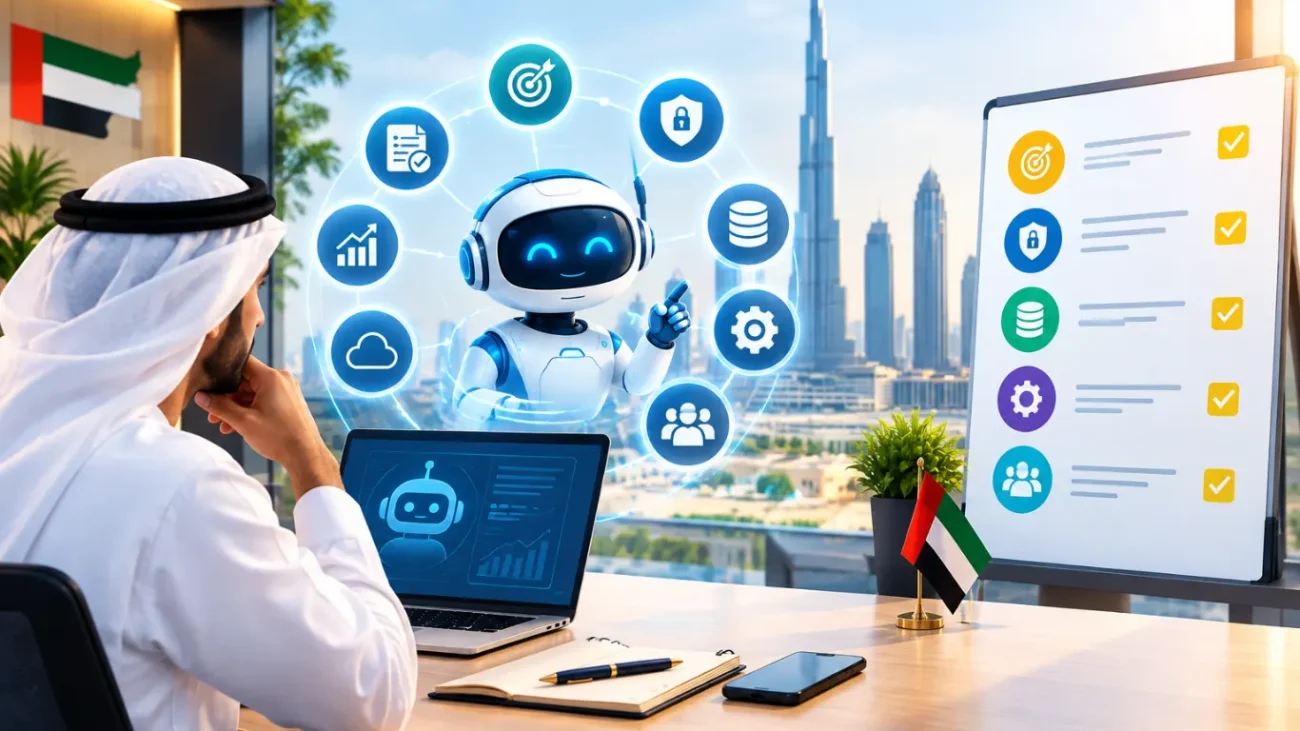
Before deploying an AI agent, businesses should first understand what the agent will do, what information it needs, which systems it will connect to, and what actions it can perform. A short security review before deployment can prevent many problems later.

A useful checklist is:

  1. Define the purpose
    What business problem will the AI agent solve?
  2. Identify required access
    What systems and data does it actually need?
  3. Limit permissions
    Remove access that is not necessary.
  4. Secure credentials
    Use proper authentication and credential management.
  5. Review integrations
    Check APIs, plugins, applications, and external services.
  6. Set monitoring rules
    Track agent activity and unusual behaviour.
  7. Establish human approval
    Decide which actions require human confirmation.
  8. Test before deployment
    Check how the agent responds to unexpected or malicious inputs.
  9. Review regularly
    Permissions and risks can change as the agent evolves.

The Future of AI Agents and Cybersecurity

AI agents are probably here to stay. But the more autonomous they get, the more work cybersecurity teams have on their hands — it’s not just about locking down users and devices anymore. Identity, permissions, who’s watching what, where the data goes, who’s accountable — all of that starts mattering a lot more once AI is actually plugged into real business systems.

This isn’t some far-off thing either. It’s happening right now. Agents are moving out of demos and into actual day-to-day work, and security folks are clearly paying more attention to what can go wrong.

For businesses here in the UAE, that’s both a chance and a bit of a responsibility. AI can take repetitive tasks off people’s hands, speed things up, help teams get more done. Good stuff. But none of that’s worth much if security takes a back seat.

At the end of the day, the businesses that really get value out of AI will be the ones that think about security from day one — not the ones patching things up after it’s already out there causing problems.

Using AI Agents? Get the Security Right First

AI agents are handy. But most businesses aren’t really set up to secure the extra access and integrations that come with them.

That’s where we can help. Our team can review your access controls, keep an eye on system activity, and make sure your wider IT security setup can handle new tools like AI agents safely — not just today’s software.

Already using AI at work, or thinking about it? Worth a quick chat before something goes wrong.

 Talk to Chipincorp about strengthening your IT security.

Conclusion

Here’s the thing about AI agents — they’re not just another piece of software sitting quietly in the background. They read, they decide, they act. Often without anyone standing over their shoulder.

Which is exactly why security can’t be something you bolt on later. It needs to be baked in from the start, especially heading into 2026.

None of this is a case against using AI. It’s a case for using it carefully. Give agents only the access they actually need — nothing more. Lock down their credentials properly. Watch what they’re doing. Stay alert to prompt injection tricks. And keep a real person in the loop for anything that matters.

For businesses in the UAE, none of this happens in isolation. It sits right alongside the security work already underway — endpoint protection, cloud security, backups, Zero Trust, managed IT support.

So the question worth asking isn’t whether to use AI anymore. Most businesses already have. It’s whether they can actually trust how it’s being used.

Frequently Asked Questions

AI agents are software systems that can understand goals, make decisions, use connected tools, and complete tasks with limited human intervention.

AI agent security is important because agents may access sensitive business data, applications, APIs, and cloud systems. Poor security can lead to data exposure or unauthorized actions.

 The main risks include excessive permissions, prompt injection, sensitive data exposure, unsafe integrations, weak credentials, poor monitoring, and lack of human oversight.

Prompt injection is an attack that uses malicious instructions to manipulate an AI agent into performing unintended actions, accessing information, or ignoring its original instructions.

 Businesses can secure AI agents using least-privilege access, strong authentication, secure credentials, activity monitoring, data protection, safe integrations, regular security reviews, and human approval for sensitive actions.

 Agentic AI security involves protecting AI agents, their identities, connected tools, data, and actions from cyber threats through access controls, monitoring, secure integrations, and governance.

 UAE businesses should identify what an AI agent can access and do, limit its permissions, protect sensitive data, secure integrations, monitor activity, test the agent, and maintain human oversight.