Blogs by Chipin

A Step-by-Step Guide: What Is an IT Infrastructure?

A Step-by-Step Guide: What Is an IT Infrastructure?

Modern businesses use many different technologies, from laptops to servers, and from software to cloud applications and security solutions. Different technologies have to be integrated through a company’s IT infrastructure.

 A small company may use IT infrastructure such as personal computers, a router, and a few cloud-based and security applications. A larger company may need a more comprehensive IT infrastructure that includes computers and servers, a data center, a network, cloud and other applications, and Integrated Systems for security and backup.

 IT Infrastructure may consist of many components. To make optimal technology choices for the business and minimize IT issues for the business, it is essential for the business to have a basic understanding of IT Infrastructure.

In this article, we discuss IT infrastructure and answer questions like what it comprises, what types are available, the key concepts involved, its security and protection, how to maintain it, and how to build an effective setup for a business.

What Is IT Infrastructure?

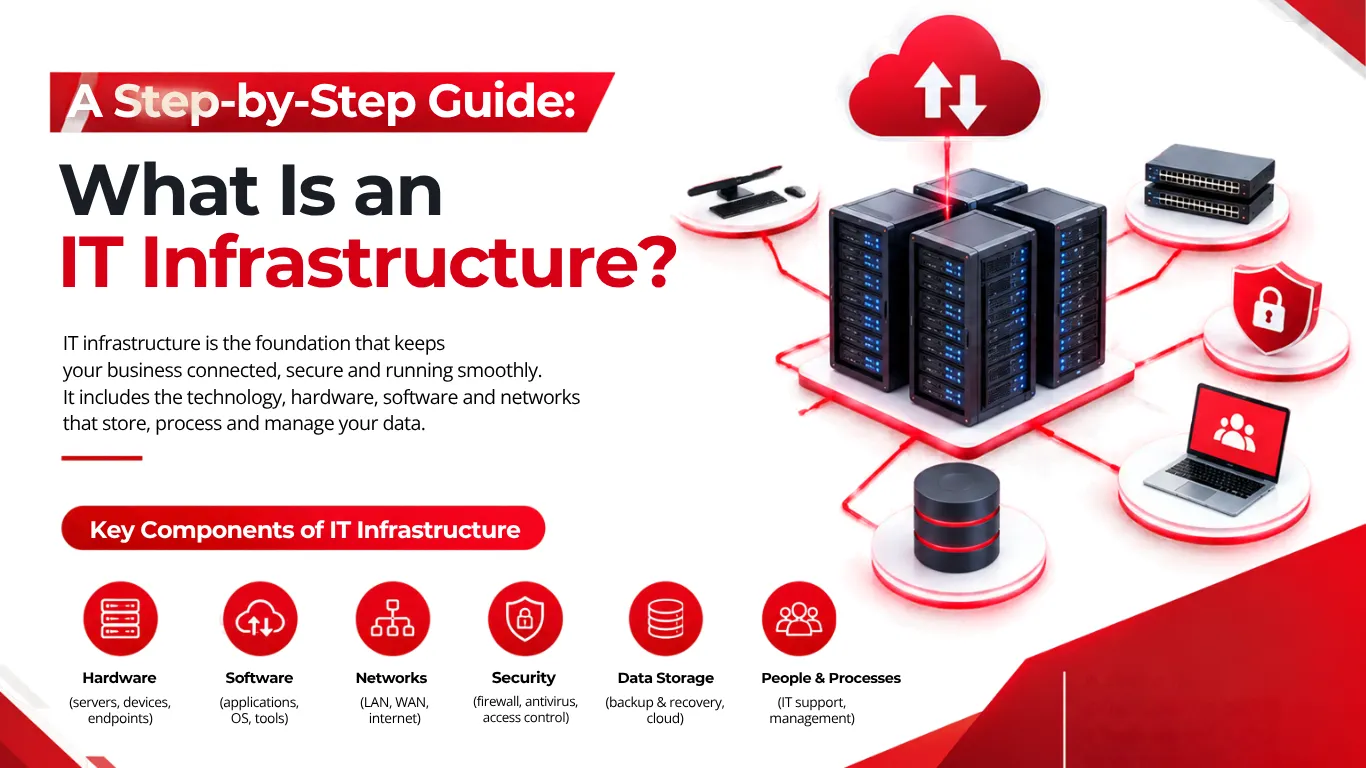
IT infrastructure is the combination of hardware, software, networks, data, cloud services, and other technology resources that a business uses to operate its IT environment. These components work together to support communication, applications, data storage, security, and everyday business operations.

Think of IT infrastructure as the foundation of a company’s technology environment. Employees may use laptops and applications every day, but those devices and applications depend on networks, servers, internet connections, security systems, and other underlying technologies.

A typical IT infrastructure can include:

  • Computers, laptops, and mobile devices
  • Servers and storage systems
  • Routers, switches, and wireless networks
  • Business applications and operating systems
  • Cloud services and platforms
  • Cybersecurity solutions
  • Backup and disaster recovery systems
  • Databases and data management tools
  • Communication and collaboration systems

The exact infrastructure depends on the size, industry, applications, and requirements of the organisation.

Why Is IT Infrastructure Important for Businesses?

IT infrastructure provides the technology foundation businesses need to run applications, communicate, store information, protect data, and support employees. A reliable infrastructure can improve productivity and help organisations maintain consistent operations as their technology needs grow.

Today, almost all business activities require the use of some form of technology. The nature of work and the types of services required to support the work have changed drastically. Employees work from various locations, communicate and collaborate through various online mediums, access and process data through electronic platforms.

If this environment fails to keep up with the services required to support the work, employees cannot perform even the most basic tasks. Poor network speed reduces employee productivity. Serious technology issues cause the inability to access business applications or support files.

This foundation allows businesses to support growth and alleviates the need to randomize and add technology. It helps support predictable business growth. The unpredictable and ever-changing nature of today’s business requires a flexible setup. This is especially true for businesses that have adopted technology for remote work and other digital services.

What Are the Main Components of IT Infrastructure?

What Are the Main Components of IT Infrastructure

The main components of IT infrastructure include hardware, software, networking, data storage, cloud services, cybersecurity, and IT management tools. Together, these elements provide the systems and connections required for employees and business applications to work efficiently.

Each component has a different role, but they are closely connected. For example, employees may use a laptop to access a cloud application through the company’s network while security tools protect the connection and backup systems protect important data.

Let’s look at the major components in more detail.

Hardware

Hardware includes the physical technology used by a business. This can include:

  • Desktop computers and laptops
  • Servers
  • Printers and scanners
  • Network switches and routers
  • Wi-Fi access points
  • Storage devices
  • Firewalls
  • Mobile devices

Hardware requirements depend on the organisation’s operations. A small office may rely heavily on cloud services and employee laptops, while a larger company may require dedicated servers and networking equipment.

Software

Software provides the applications and operating systems employees use to perform their work.

Examples include operating systems, accounting software, customer relationship management platforms, productivity applications, databases, security software, and business-specific applications.

Software also needs to be maintained regularly. Updates can introduce new features, improve performance, and address security vulnerabilities.

Networking

Networking connects devices, systems, employees, and applications. It can include wired Ethernet connections, Wi-Fi networks, routers, switches, firewalls, VPNs, and internet connectivity.

A properly designed business network allows users and devices to communicate while controlling who can access specific resources.

Data Storage

Businesses generate and store large amounts of data, including documents, customer information, financial records, emails, databases, and application data.

Storage infrastructure can include physical servers, network-attached storage, cloud storage, and other data storage platforms.

Businesses also need appropriate backup systems so that important information can be recovered if it is accidentally deleted, corrupted, or affected by a security incident.

What Are the Different Types of IT Infrastructure?

IT infrastructure can generally be classified into traditional, cloud, hybrid, and virtualised environments. The main difference is where computing resources are hosted and managed, whether on physical business premises, in the cloud, or through a combination of both approaches.

Traditional IT Infrastructure

Traditional infrastructure, otherwise known as on-premises infrastructure, is comprised of computer hardware and services that a company provides and manages on its own premises.

Some examples of infrastructure that a company could own and manage include servers, data links, and storage devices.

A primary benefit of owning and managing infrastructure is control. However, ownership of infrastructure means a company must manage and maintain the hardware, secure the hardware, and plan for the optimal use of the hardware.

Cloud IT Infrastructure

Cloud infrastructure moves computing resources from on-premises hardware and software to the hardware and software of a cloud service provider. It provides a greater level of flexibility for a business because it is no longer tied to its own infrastructure for storage, applications, servers, and databases.

Also, with cloud infrastructure, there is the opportunity to dynamically change the level of resources a business uses based on demand.

Nevertheless, the addition of cloud infrastructure does not eliminate IT management. A business is still responsible for security and access management for users, data protection and backups, and control over cost and configuration management.

Hybrid IT Infrastructure

Hybrid infrastructure combines on-premises technology with cloud services.

For example, a business may keep certain systems or sensitive workloads on local servers while using cloud platforms for email, collaboration, backup, or other applications.

This approach can be useful for organisations that need to maintain existing infrastructure while gradually adopting cloud technology.

Virtualised Infrastructure

Virtualisation allows physical computing resources to run multiple virtual environments. Instead of dedicating one physical server to every workload, organisations can use virtual machines to make better use of available resources.

Virtualisation is commonly used for servers, development environments, testing, and other workloads.

How Does IT Infrastructure Work Together?

IT infrastructure works as an interconnected environment where devices, networks, software, servers, cloud platforms, security systems, and storage communicate with one another. A problem in one component can sometimes affect several connected business services.

An example of this is an employee using a business application.

The employee uses a laptop to connect to the business application. The laptop connects to the business network using Wi-Fi. The employee’s laptop connects to an internal server using the business network. The server processes the application request and retrieves data. The data can be stored in a business database or in a cloud service.

There may be security controls to assess the employee’s laptop and the user’s access rights and determine if the employee is engaging in any suspicious activities.

As shown above, various components of this environment are interrelated and interdependent. A good setup focuses on integrating components of the infrastructure instead of acquiring individual components.

What Is the Role of Network Infrastructure?

What Is the Role of Network Infrastructure?

Network infrastructure provides the connectivity that allows computers, servers, applications, employees, and other devices to communicate. It includes equipment such as routers, switches, access points, firewalls, cables, and network management technologies.

Wired and wireless connections comprise a network infrastructure. Ethernet connections are used for desktop computers and server connections. Wi-Fi connections offer more flexibility for laptop and other portable connections.

This also impacts overall performance. It can also result in a variety of performance issues including slow connection speeds and access to applications, communication issues and loss of wireless connections.

Designing and implementing appropriate security features to protect this connectivity layer and applications is essential.

Due to increased usage and adoption of cloud applications and remote work, the network infrastructure must also support the required connections.

How Does Cybersecurity Fit Into IT Infrastructure?

Cybersecurity is an essential part of IT infrastructure because it protects devices, networks, applications, accounts, and business data from unauthorized access and cyber threats. Security should be built into the infrastructure rather than treated as a separate layer added after deployment.

Modern business environments face risks such as phishing, malware, ransomware, stolen credentials, insecure devices, and unauthorised access.

A complete security approach may include:

  • Firewalls and network security
  • Endpoint protection
  • Multi-factor authentication
  • Email security
  • Access controls
  • Security monitoring
  • Regular software updates
  • Employee security awareness
  • Data backup and recovery

Security requirements can vary depending on the organisation and the type of information it handles.

For example, a business storing sensitive customer or financial information may require stronger access controls and monitoring than a basic office environment.

What Is IT Infrastructure Management?

IT infrastructure management is the process of monitoring, maintaining, securing, and improving the technology systems a business relies on. It covers areas such as hardware, software, networks, servers, cloud services, security, performance, and technical support.

The goal of IT infrastructure management is to identify and fix potential technology issues before they affect employees and/or customers. Managers monitor systems to identify potential problems and/or help desks to identify support issues.

Issues or support tickets can be addressed in a number of ways including support call resolution, desktop support, and help desk call resolution. Other management activities can include modifying and upgrading hardware and/or software, and performing user access control and system backups.

Many small and medium businesses engage IT support companies to help them address monitoring, management and support activities for their infrastructure systems.

How Should Businesses Maintain Their IT Infrastructure?

Businesses should maintain IT infrastructure through regular monitoring, updates, security checks, backups, hardware reviews, performance testing, and documentation. Proactive maintenance helps identify potential issues early and keeps technology aligned with changing business requirements.

IT infrastructure should not be treated as something that only needs attention when something stops working.

A proactive maintenance approach can include:

  • Checking system and network performance
  • Installing important software and security updates
  • Reviewing storage capacity
  • Testing backups
  • Monitoring security alerts
  • Replacing outdated hardware
  • Reviewing user access
  • Documenting infrastructure changes

Regular maintenance can reduce unexpected downtime and help businesses understand when systems need to be upgraded or replaced.

How Can Businesses Improve Their IT Infrastructure?

Businesses can improve IT infrastructure by first assessing their existing environment, identifying performance and security gaps, prioritising business requirements, and creating a practical improvement plan. Upgrades should solve real operational problems rather than simply adding new technology.

A useful starting point is an IT infrastructure assessment.

Businesses can review:

  • Existing hardware and software
  • Network performance and reliability
  • Server and storage capacity
  • Cloud applications and services
  • Cybersecurity controls
  • Backup and disaster recovery processes
  • Employee technology requirements

After identifying weaknesses, businesses can prioritise improvements based on business impact, security requirements, budget, and future growth.

For example, a company experiencing frequent network interruptions may benefit more from improving its network infrastructure than from purchasing additional software.

What Are Common IT Infrastructure Challenges?

Common IT infrastructure challenges include outdated hardware, unreliable networks, cybersecurity risks, poor documentation, insufficient backups, limited scalability, and unexpected downtime. These issues can increase costs and affect employee productivity when they are not identified and addressed early.

Some businesses have a piecemeal approach to IT infrastructure. As a result, these businesses may use inconsistent and unmanaged IT services.

This approach often leads to insecure and unintegrated IT services.

Additionally, many IT services are managed using an ad hoc approach to integrating numerous cloud applications. Often, the lack of oversight leads to the inability to determine the legitimate users of business information, and promotes the use of unauthorized applications.

Periodic assessment of business infrastructure helps to eliminate disorganization in business IT services.

IT Infrastructure vs IT Architecture: What Is the Difference?

IT Infrastructure vs IT Architecture What Is the Difference

IT infrastructure refers to the actual technology components and resources a business uses, while IT architecture describes how those components are designed, organised, and connected. Infrastructure is the foundation; architecture provides the overall structure and design for using it effectively.

For example, servers, networks, storage devices, and cloud services are part of IT infrastructure.

IT architecture focuses on how those technologies should interact to meet business requirements.

The two concepts are closely connected. Good architecture can help businesses build an infrastructure that is scalable, secure, manageable, and aligned with their operational goals.

How Does IT Infrastructure Support Business Growth?

A scalable IT infrastructure helps businesses add employees, applications, devices, locations, and digital services without constantly rebuilding their technology environment. Planning for scalability allows organisations to respond to growth while maintaining performance, security, and reliable access to essential systems.

To accommodate growth, a business may need more laptops, storage, and other IT resources.

Rigid IT infrastructure designed to support the current size of the business may lead to IT performance and management problems.

Flexible or scalable infrastructure provides the business the ability to support the core functions of the business and still allow for growth of the business.

It is essential for a business to have the right technology to support its business functions and still allow the business to meet the expected business demands.

Ready to Strengthen Your IT Infrastructure?

A reliable IT infrastructure keeps your business connected, secure, and ready to grow. Chipin Corp provides professional IT infrastructure solutions in Dubai, helping businesses manage their networks, servers, cloud systems, security, and overall IT environment.

 Talk to Chipin Corp IT Experts Today

Final Thoughts

A business’s IT infrastructure includes hardware, software, networks, data, and other elements. A business’s IT infrastructure is essential for connecting and integrating different elements of the business. It enables a business to be more productive and strengthens a business for future growth.

A business needs to evaluate its IT infrastructure to improve its management. A business needs to evaluate the ongoing technology environment, identify weaknesses, and strengthen and enhance the environment. Enhancement should be based on the needs of the business.

A business should use a mixture of on-premises environments, and cloud environments to maximize efficiency and productivity. A business should integrate different digital systems to achieve its business goals.

The more reliant a business is on digital systems, the more important it is to manage a business’s IT infrastructure. It enables the business to achieve its goals and objectives and allows employees to perform their job functions. Additionally, it enables a business to protect its data and other information.

Frequently Asked Questions

IT infrastructure is the technology foundation of a business. It includes computers, servers, networks, software, cloud services, storage, security systems, and other resources that help employees perform their daily work.

The five broad components are hardware, software, networking, data/storage, and services. Modern IT infrastructure may also include cloud computing, cybersecurity, virtualisation, backup, and infrastructure management tools.

IT infrastructure supports everyday business operations by connecting employees, applications, devices, data, and communication systems. Reliable infrastructure can improve productivity, security, availability, and the ability to scale as the business grows.

IT infrastructure refers to the actual technology resources used by a business, while IT architecture focuses on how those resources are designed, organised, and connected to meet business and technical requirements.

Cloud IT infrastructure provides computing resources such as servers, storage, databases, networking, and applications through cloud platforms. Businesses can use these resources without managing all of the underlying physical infrastructure themselves.

There is no single review schedule that fits every business, but infrastructure should be monitored continuously and reviewed regularly. Major changes such as business growth, new applications, cybersecurity incidents, or office expansion may also require an additional review.

Yes. A small business can have a complex IT environment if it uses multiple cloud applications, remote employees, business software, connected devices, servers, security systems, and different communication platforms. The complexity depends more on the technology environment than employee count.