Blogs by Chipin

Cybersecurity Checklist for Trading and Distribution Companies in Dubai

Cybersecurity Checklist for Trading and Distribution Companies in Dubai

Trading and distribution companies in Dubai rely on business connectivity. They use technology for almost all the processes from dealing with clients to keeping track of payments, tracking shipments, managing inventory, and managing employee data.

This reliance on technology leaves trading and distribution companies in Dubai with numerous risks in cybersecurity. One example is payment fraud which is a consequence of an email address being hacked. In addition, ransomware can make critical business systems unavailable, disrupting normal business operations. Other risks in cybersecurity are weak passwords, out-of-date programs, poorly secured remote access, and unprotected links to third-party vendors.

Cybersecurity is therefore not simply an IT concern. It is an important part of protecting business operations, financial information, customer relationships, and long-term business continuity. 

Below is a list of high priority cybersecurity concerns among trading and distribution companies in Dubai.

Why Cybersecurity Matters for Trading Companies

Trading and distribution businesses work with tons of commercial information. This can be anything from supplier contracts to customer information to orders, invoices and pricing, inventory info, and financial and shipping documents. It all includes information about employees.

Many of these companies use integrated systems and applications like Microsoft 365, warehousing systems, accounting applications, cloud applications, and ERP systems. One single outage can affect multiple different areas in the company.

Using an example, imagine employees cannot process orders or read information about their delivery status because the ERP system had been affected by ransomware.

Cybersecurity is the answer to this problem. It helps businesses defend against digitally-focused crimes from stealing information or accessing it unlawfully, ensuring that sensitive company data and systems they protect are safe from malware or other threats.

The UAE has developed national cybersecurity policies and frameworks to strengthen information security and digital resilience, making security an important consideration for organizations operating in the country’s digital economy. 

What Cyber Threats Are Commonly Targeting Trading Businesses?

What Cyber Threats Are Commonly Targeting Trading Businesses

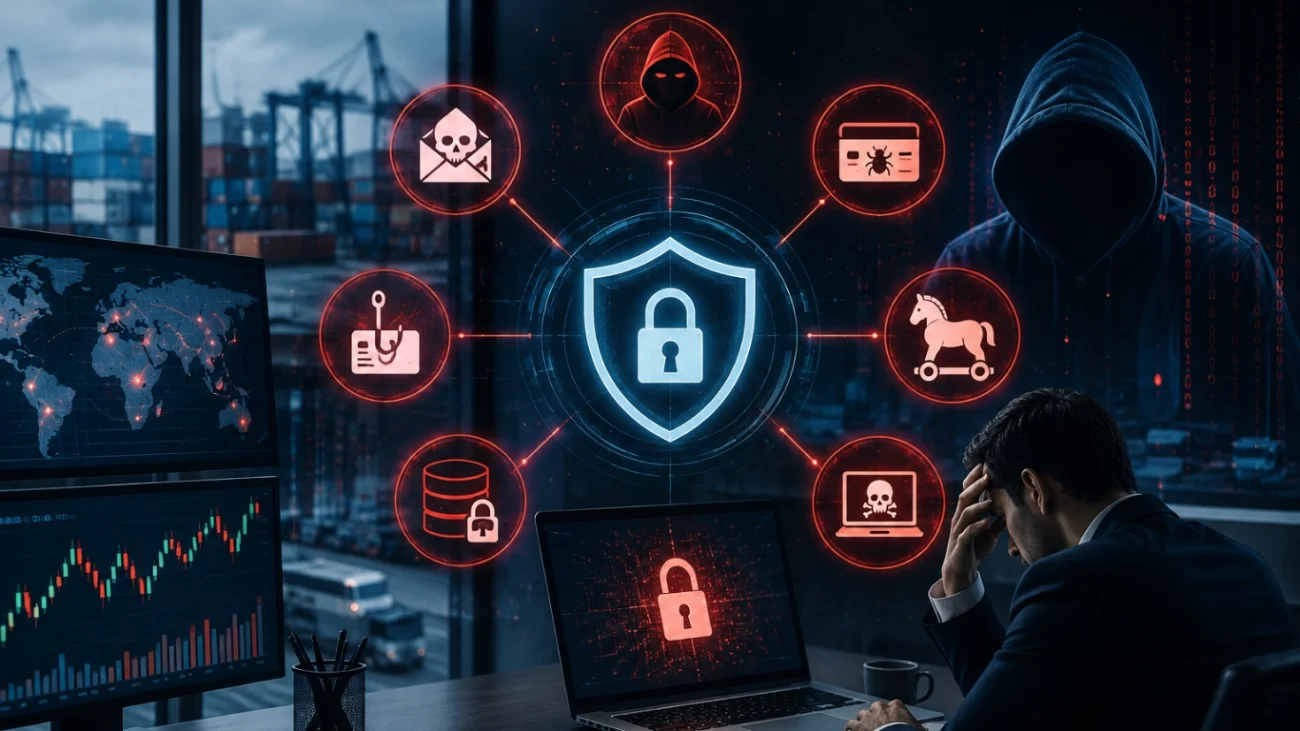
Trading companies can face many of the same cyber threats as other businesses, but their interconnected operations can make certain attacks particularly disruptive.

Ransomware

Ransomware can be used against all types of businesses, but a trading company can be impacted in higher, more visible ways. Ransomware has a high impact on a trading company because employees may lose access to critical systems that support the ordering and logistics of a business, accounting, or even customer service. 

Phishing Attacks

Phishing attacks are often used to trick employees into clicking a malicious link or opening a malicious document and are often disguised as emails from collaborators or even a company’s bank. 

Business Email Compromise

Communication via email is a primary means of communicating purchase orders, payment instructions, or even trading directly with suppliers. An attacker who gains access to an employee’s mailbox may monitor conversations and use that information to create convincing fraudulent requests. 

Credential Theft

Passwords used to access mail and cloud resources can be reused, weak, or stolen. This directly gives access to a business resource.

Malware

Systems and other resources can be infected with malware by downloads, documents, or emails that are accessed from compromised systems or websites. 

Supply Chain Attacks

Trading companies work with many suppliers, logistics companies and contractors, and technology vendors. One technology vendor with poor security poses a growing risk to the trading company as a whole. 

Understanding these threats is the first step toward developing an effective security strategy.

Cybersecurity Checklist for Trading and Distribution Companies

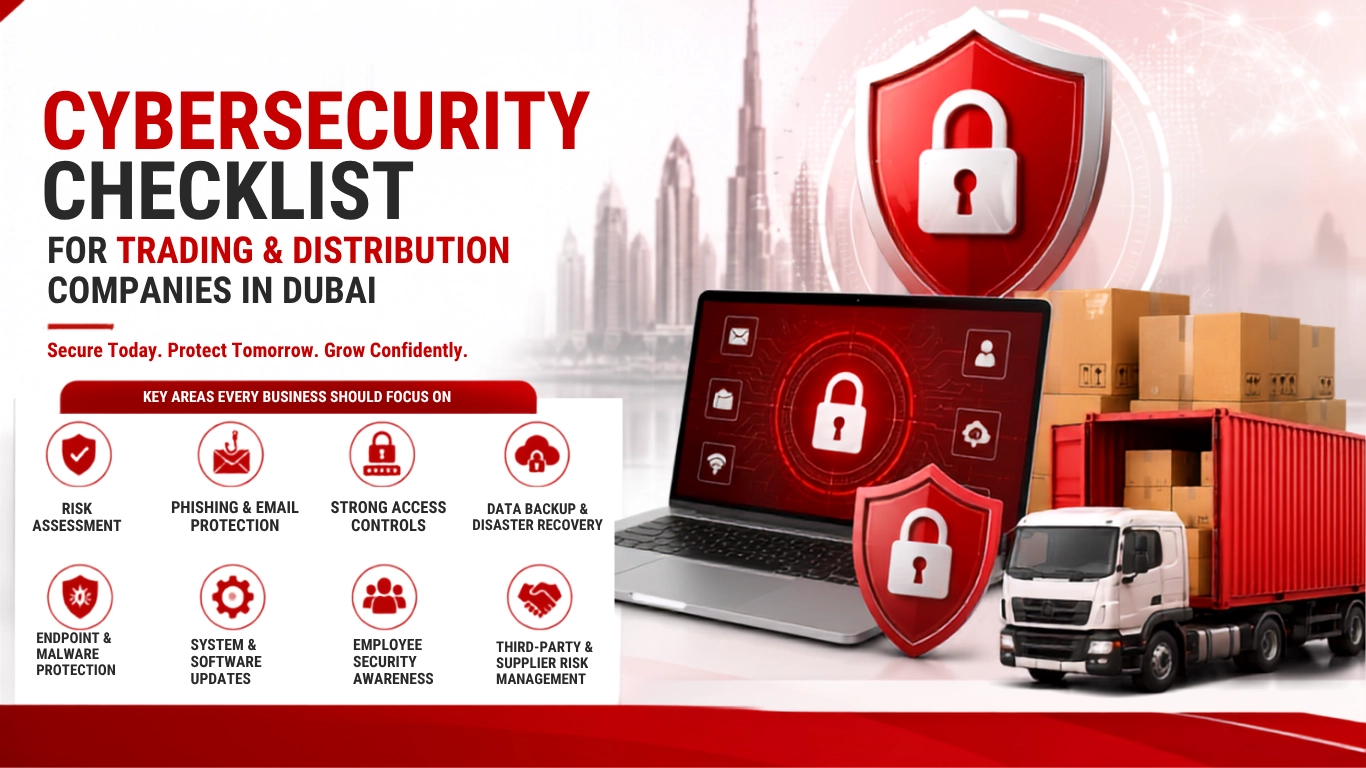
A strong security program should cover technology, employees, business processes, and third-party relationships. The following 11 areas provide a practical starting point for businesses reviewing their current security posture.

1. Conduct a Cybersecurity Risk Assessment

It’s important to understand what you are trying to protect before any new security tools are brought online.

Initially, what is important to a business may be its systems, devices, data, and business applications (and of course, users). Consider what systems would create the greatest disruption if they were no longer available.

A risk assessment should examine:

  • Critical business applications
  • Servers and endpoints
  • Cloud services
  • Network infrastructure
  • Sensitive information
  • User permissions
  • Remote access
  • Third-party connections
  • Existing security controls

Businesses also need to examine the possible impact of various business disruptions. Losing an employee laptop may just be inconvenient, whereas losing access to the ERP or financial systems may present a significant business disruption.

Routine assessments assist businesses in allocating resources to address the most important risks.

2. Secure Business Email and Microsoft 365

Email is a primary route attackers take to target businesses.

Trading and distributing companies must protect their business email with strong authentication and anti-phishing controls along with spam and malware filtering, suspicious login alerts, and appropriate access controls.

Multi-factor authentication should be enabled for important accounts wherever possible. 

Employees should not be fooled by password reset emails, suspicious attachments, or last-minute requests from management. 

Email security is of critical importance while employees work with payment information, requests, contracts, and purchase orders.

3. Protect Endpoints Across the Business

All devices that connect to the business network are attack endpoints.

Each business device should be documented and have business endpoint protection assigned to it.

Business security controls should be applied to all devices, no matter their location. These include shipping warehouse computers, devices in company branches, and all devices in remote work situations.

Looking at network activity on a regular basis can assist in detecting new attacks, viruses, and other unapproved applications.

Protection of endpoints will be most effective when used in conjunction with regular updates of approved software and the use of good user access management.

4. Strengthen Network Security

Appropriate network design can contain threats and defend critical assets.

Trading companies should look at the use of firewalls, wireless connection security, remote access and connections to the network and virtual private networks. They should also review guest connections to their networks and connection controls to their critical applications and services.

Guest Wi-Fi should be completely separate from internal business networks. 

Network protection equipment such as routers and switches should have security updates along with firewalls and wireless access points.

Review the network regularly to identify access that is not needed, exposed services, and weak configurations.

5. Implement Strong Identity and Access Management

Employees need only the required access to the systems and information they use in their job function.

For instance, an employee working in warehouse operations might not need administrative access to the financial systems, but may need access to the inventory application.

The principle of least privilege can help reduce unnecessary exposure.

Businesses should regularly review:

  • User accounts
  • Administrator accounts
  • Privileged access
  • Remote access
  • Application permissions
  • Former employee accounts

When an employee leaves the organization, access should be revoked quickly. An employee should be restricted to the least needed access when they have a role change.

The risk of credential access is significantly less with strong identity controls.

6. Keep Systems, Applications, and Software Updated

Attackers look for attack opportunities in obsolete and outdated software.

Trading businesses use several applications such as OS, ERP, Accounting, WMS, browsers, databases, cloud applications, and network devices.

A structured patch-management process helps ensure important security updates are applied consistently.

Organizations need to have an understanding of all the software used and need to identify systems with an extended supportability gap.

If obsolete systems cannot be replaced, access and controls such as network isolation can be restricted.

7. Protect Business Data With Secure Backups

Data gets lost due to a variety of reasons ranging from a ransom request to malicious intent, to accidental deletions and hardware/software failures.

Regular backups of important business data are absolutely essential.

Backups should be:

  • Automated where possible
  • Protected from unauthorized access
  • Monitored regularly
  • Encrypted where appropriate
  • Stored separately from production systems
  • Tested through restoration exercises

Business data criticality can range from customer data, financial records, data housed in enterprise resource planning (ERP) systems, contracts, records of commerce, and operational data.

An effective backup strategy is about more than just generating an offsite copy of data. It is about making sure that data can be restored at a given time.

8. Create a Practical Incident Response Plan

Businesses should know what to do when a cyber incident occurs.

An incident response plan should identify who is responsible for managing an incident and what actions should be taken during the early stages.

It should cover situations such as:

  • Ransomware
  • Compromised accounts
  • Malware infections
  • Data exposure
  • Unauthorized access
  • Major system outages

The plan must also provide contact details for internal participants, describe how to isolate affected systems, and the steps that must be taken to recover the affected systems and the means for communication. 

Regular testing can help employees understand their roles before a real incident occurs.

9. Train Employees Against Phishing and Social Engineering

Employees are the foundation of a company’s security structure.

Awareness of the types of threats and attacks employees are likely to encounter during the course of their daily work is crucial. Awareness of various cyber threat vectors, e.g. phishing, fake login pages, malicious attachments, spear-phishing, social engineering, atypical payment requests, is a good starting point.

Training should relate to the employee’s actual duties.

A finance employee will need training to spot payment change requests. A warehouse employee will need training to spot unauthorized access to company resources and may need training to spot threatening files.

Security awareness training of employees reduces the time it takes for employees to spot threats and successful attacks.

10. Manage Third-Party and Supply Chain Risks

Trading and distribution companies rely heavily on external businesses.

Suppliers, logistics companies, contractors, software providers, and other business partners may have access to business information or systems.

Before granting access, organizations must know what information each third party needs and grant only the necessary privileges.

Businesses must also routinely evaluate their third-party access and revoke access for accounts that are no longer necessary.

Security requirements can be added to vendor contracts when needed.

The contracted third parties must be managed to reduce the risk of having an interconnected business.

11. Test Your Disaster Recovery and Business Continuity Plan

An attack in the cyber world can disrupt a business’s ability to continue normal operations. This disruption stems from employees’ inability to access systems.

An adequate disaster recovery plan should define the restoration priority of systems, the restoration duty owners, the backup restoration locations, and how employees can conduct their duties while waiting for services to be restored.

Recovery procedures should be tested rather than simply documented.

Testing can identify practical problems such as missing information, outdated procedures, insufficient backup capacity, or unclear responsibilities. 

For trading companies, a strong recovery plan reduces the time of business disruption after a major business security event.

Protecting Financial Transactions in Trading Businesses

Financial transactions pose unique challenges for trading companies.

Since trading companies often deal with significant volumes of financial transactions (invoicing, payments, orders, refunds, etc), financial processes become a high risk security concern for trading companies. Fraudsters or hackers may attempt to breach financial processes through compromised accounts or fake communications.

Companies should create a standard for verifying requests to change banking information and payment requests which are uncharacteristic.

Important financial controls can include:

  • Multiple levels of approval
  • Independent verification of payment changes
  • Restricted access to financial systems
  • Multi-factor authentication
  • Regular account reviews
  • Monitoring for unusual transactions

Employees should not take email requests for significant financial transactions at face value. The risk of payment fraud is greatly reduced by verifying payment requests through established communication channels. 

Cybersecurity for ERP and Inventory Management Systems

Cybersecurity for ERP and Inventory Management Systems

Since most operations systems connect purchasing, selling, inventories, finances, customer accounts, and reporting, they tend to be the backbone of trading operations.

Because these systems integrate with many others, their exposure encourages bad actors to go after multiple departments within the organization.

In this light, protection of ERP and Inventory Management Systems should be of great concern to organizations.

Organizations need to review the permissions given to their users and administrators, authentication, software updates, and the system backups, as well as integrations and external network access to the system.

Extra accounts should be removed, and access given to certain users/accounts should be limited.

In the absence of regular and frequent system backups and recovery drills, restoring systems to operational state in the aftermath of a major disruption to operations may not be possible.

How Cybersecurity Supports Business Continuity

Business continuity and cybersecurity should not be treated as completely separate functions.

A cyberattack can affect communication, finance, inventory, logistics, customer service, and other departments at the same time.

A resilient organization should understand which processes are essential and how they would continue during a technology disruption.

For example, if a critical business application becomes unavailable, management should already know:

  • Which operations are most important
  • Which systems need priority recovery
  • Who makes recovery decisions
  • How employees will communicate
  • How customers will be supported
  • How essential data will be restored

This approach helps businesses move from simply preventing attacks to preparing for disruption when prevention fails.

Building a Long-Term Cybersecurity Strategy

Cybersecurity should not be treated as a one-time project.

Threats change, businesses grow, employees change roles, new software is introduced, and companies establish new supplier relationships. Each change can create new security considerations.

A long-term strategy should include regular security assessments, employee awareness programs, software patching, access reviews, backup testing, network monitoring, vulnerability management, and periodic policy updates.

Businesses should also review their security strategy whenever they:

  • Open a new branch
  • Move to a new office
  • Introduce a new ERP system
  • Adopt new cloud services
  • Add remote employees
  • Change major suppliers
  • Acquire another business
  • Expand into new markets

Continuous improvement allows security controls to evolve alongside the organization.

Why Managed Cybersecurity Services Can Benefit Dubai Businesses

Why Managed Cybersecurity Services Can Benefit Dubai Businesses

Not every distribution or trading business has the resources to build their own internal security team.

Managing security alerts, endpoint protection, networks, backups, cloud platforms, user accounts, vulnerabilities, and incident response can require specialized knowledge and continuous attention.

IT and cybersecurity managed services can help businesses provide access to the skills and solutions to maintain secure services.

This approach is helpful to businesses that want to improve their security posture without building a big internal cybersecurity division.

What is important is that the provider understands the existing operations of the business and the services and technologies that the business is using so that they can integrate their security services.

Why Choose Chipincorp for Cybersecurity in Dubai?

Businesses need cybersecurity solutions that fit their actual infrastructure rather than generic security products that are difficult to manage.

At Chipincorp, we help businesses strengthen their IT environments through practical technology and security solutions.

Our approach can support organizations with areas such as:

  • Network and infrastructure security
  • Endpoint protection
  • Backup and recovery
  • Microsoft 365 security
  • Managed IT services
  • Cloud solutions
  • IT monitoring
  • Cybersecurity solutions

For trading and distribution companies, the objective is to protect critical systems while keeping everyday operations efficient and reliable.

If you are reviewing your company’s security posture, Chipincorp can help identify potential gaps and develop an approach suited to your business requirements.

Need help strengthening your cybersecurity in Dubai? Contact Chipincorp today to discuss your IT security requirements and protect your business against evolving cyber threats.

Conclusion

For trading and distribution companies in Dubai, cybersecurity is closely connected to business continuity, financial protection, operational efficiency, and customer trust.

The right strategy should go beyond installing security software. Businesses need to assess their risks, protect critical systems, control user access, secure networks, train employees, manage third parties, maintain reliable backups, and regularly test their recovery plans.

By following a structured cybersecurity checklist and continuously improving security practices, trading and distribution companies can build a stronger defense against evolving threats while keeping their operations resilient.

For professional IT and cybersecurity support in Dubai, Chipincorp can help your business evaluate its technology environment and implement practical security solutions designed around its operational needs.

Protect your business before a cyber incident becomes a business disruption. Get in touch with Chipincorp today.

Frequently Asked Questions

Cybersecurity for a trading company involves protecting its computers, networks, applications, cloud platforms, users, data, and business systems from unauthorized access, malware, fraud, and other cyber threats.

Trading companies rely on technology for communication, financial transactions, inventory, purchasing, sales, logistics, and customer management. A cyber incident can therefore affect several parts of the business simultaneously.

There is no single risk that affects every company equally. However, phishing, business email compromise, ransomware, stolen credentials, outdated systems, and third-party risks are common areas that businesses should assess.

Companies can reduce ransomware risk through endpoint protection, network security, regular patching, multi-factor authentication, employee training, restricted access, monitoring, and secure, tested backups.

The appropriate frequency depends on the organization's size, infrastructure, risk profile, and requirements. Businesses should conduct regular reviews and reassess security whenever major systems, employees, locations, or third-party relationships change.

Yes. Managed IT services can help businesses monitor and maintain their IT environment, manage security controls, apply updates, protect endpoints, maintain backups, and identify potential issues before they become larger problems.

Chipincorp provides IT and cybersecurity-focused solutions for businesses, including network security, endpoint protection, backup and recovery, Microsoft 365, managed IT services, and related infrastructure solutions.