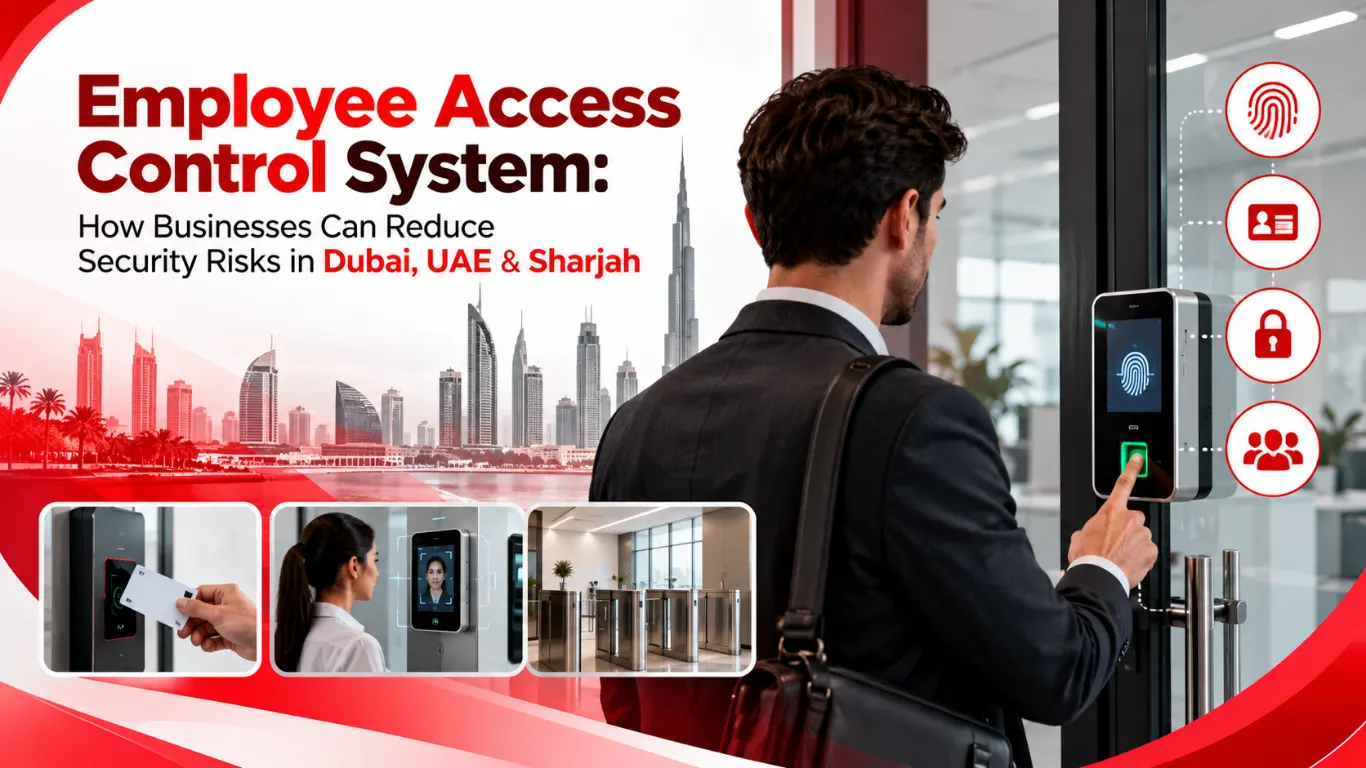
Workplace security has become an important priority for businesses across Dubai, UAE, and Sharjah. As companies expand their offices, employee teams, and technology infrastructure, controlling who can enter a workplace and access restricted areas becomes increasingly important. Traditional keys and manual attendance registers may not provide the level of control and visibility that modern businesses require.
An employee access control system helps businesses manage workplace entry by allowing authorized employees to access specific areas based on their credentials and permissions. Depending on the system, businesses can use biometrics, access cards, PINs, or other authentication methods to verify employees before granting access.
For businesses in Dubai and across the UAE, access control can also be connected with employee attendance, CCTV, and other workplace security technologies. When properly planned and managed, it can become an important part of a company’s overall physical and IT security strategy.
What Is an Employee Access Control System?
An employee access control system is a technology-based solution that manages who can enter a workplace, when they can enter, and which areas they are authorized to access.
Instead of giving every employee the same level of access, businesses can create permissions according to job roles and responsibilities. For example, an employee may be allowed to enter the main office but may not have permission to enter the server room, finance department, storage area, or other restricted locations.
Modern systems can use different authentication methods, including:
This makes it easier for businesses to control physical access while maintaining a more organized record of employee entry and exit activity.
Why Do Businesses in Dubai and UAE Need Access Control?
Businesses today manage more than employees and office space. They also handle computers, servers, networking equipment, confidential documents, customer information, inventory, and other valuable assets.
A lost key or shared access card can create a security gap. Manual entry records can also make it difficult to determine who accessed a particular area at a specific time.
An access control system in Dubai can help businesses create a more controlled workplace environment by restricting access to authorized users. It can also make it easier for administrators to change permissions when an employee joins a company, changes departments, or leaves the organization.
This is particularly useful for businesses with multiple departments, restricted areas, warehouses, server rooms, or larger employee teams.
How Employee Access Control Helps Reduce Security Risks
1. Restricts Unauthorized Access
One of the main purposes of an access control system is to prevent unauthorized people from entering restricted areas.
Businesses can assign access permissions according to employee roles. For example, the IT team may require access to a server room, while general employees may only need access to common office areas.
This approach helps reduce unnecessary physical access and gives businesses greater control over sensitive locations.
2. Protects Sensitive Areas and Business Assets
Not every part of a workplace contains the same level of risk.
Server rooms, finance departments, HR offices, warehouses, storage rooms, and management areas may contain sensitive information, expensive equipment, or valuable business assets.
With an employee access control system, businesses can limit these areas to authorized personnel.
This creates an additional layer of physical security around important business resources instead of relying only on conventional locks or security personnel.
3. Creates Better Visibility Into Access Activity
Modern access control systems can maintain records of access activity, depending on the system and configuration.
Administrators may be able to review information such as which employee accessed a controlled entry point and when the access occurred.
This can be useful when businesses need to investigate unusual activity or review an access-related incident.
Rather than relying entirely on manual records, businesses can use digital access information to improve accountability and security management.
4. Makes Employee Access Easier to Manage
Employee access requirements can change frequently.
A new employee may need access to specific departments. An existing employee may move to another team. A manager may require access to additional areas. When an employee leaves, their access should no longer remain active.
A centralized employee access management system makes these changes easier to administer.
Businesses can update permissions based on current employee responsibilities instead of continuing to use the same access level for everyone.
Types of Employee Access Control Systems
Different businesses have different security requirements. The appropriate access control technology depends on factors such as the workplace environment, number of employees, entry points, security requirements, and existing infrastructure.
Biometric Access Control
Biometric access control identifies employees using characteristics such as fingerprints or facial recognition.
Because authentication is linked to the individual, biometric systems can reduce some of the issues associated with lost, borrowed, or shared access cards.
For businesses looking for biometric access control in Dubai, the system should be selected according to the organization’s security requirements and operational environment.
RFID and Access Card Systems
RFID and proximity cards are commonly used in offices and commercial environments.
Each employee can receive an individual credential that can be used at authorized entry points. If a card is lost or an employee leaves the company, the corresponding credential can be disabled.
These systems can be practical for businesses that need to manage access for a large number of employees.
PIN-Based Access Control
PIN-based systems require users to enter a designated code to gain access.
They can be suitable for certain offices or restricted areas. However, businesses should consider the possibility of PIN sharing and choose an authentication method that matches the required security level.
Mobile Access Control
Some modern access control solutions allow employees to use mobile devices as access credentials.
This can provide another flexible option for businesses that want to reduce their dependence on physical access cards.
The best solution depends on the organization’s specific requirements rather than simply choosing the newest technology available.
Access Control and Employee Time Attendance
Access control can also work alongside employee time attendance systems.
For example, employees may use a biometric device when entering or leaving the workplace. Depending on the system, the same interaction can be used to record attendance information.
This can help businesses reduce manual attendance processes and bring access and attendance management into a more connected system.
For businesses in Dubai and Sharjah with larger teams, integrating access control with time attendance can simplify daily administration and provide management with more organized employee records.
However, access control and attendance requirements should be assessed separately to ensure that the selected solution supports the organization’s actual operational needs.
Access Control for Different Businesses in the UAE
Employee access control is not limited to large corporate offices. Different types of businesses can use it according to their workplace requirements.
Corporate Offices
Companies can use access control to manage employee entry and restrict departments such as HR, finance, IT, and management areas.
Warehouses and Logistics Facilities
Warehouses can use controlled access to protect inventory, equipment, loading areas, and restricted storage locations.
Retail Businesses
Retail businesses may use access control for stock rooms, administrative offices, employee-only areas, and other restricted spaces.
IT and Server Facilities
Server rooms contain critical technology infrastructure and should generally have controlled physical access. Restricting entry can help reduce the risk of unauthorized physical interaction with business systems.
Schools and Other Institutions
Educational and institutional environments can use access control to manage entry into administrative offices, staff areas, laboratories, and other controlled locations.
The access strategy should always reflect the organization’s layout, users, security requirements, and daily operations.
What Should Businesses Consider Before Choosing an Access Control System?
Choosing an access control system for businesses in Dubai should start with understanding the organization’s requirements rather than selecting a device based only on price.
Number of Employees
A small office with a single entrance may have very different requirements from a company with hundreds of employees and multiple locations.
Number of Access Points
Businesses should identify which doors or areas require controlled access and whether additional access points may be needed as the company grows.
Authentication Method
Organizations should determine whether biometric, RFID, PIN, mobile, or a combination of authentication methods is suitable for their workplace.
Integration With Existing Systems
Businesses may want their access control system to work alongside time attendance, CCTV, networking, alarms, or other workplace technologies.
Scalability
The solution should be capable of supporting future growth. Adding employees, departments, doors, or locations should be manageable without requiring a complete replacement of the system.
Administration and Reporting
Administrators should be able to manage users, update permissions, deactivate credentials, and review available access information efficiently.
Installation and Technical Support
The reliability of an access control solution depends not only on the hardware but also on correct installation, configuration, network connectivity, maintenance, and ongoing technical support.
Why Professional Access Control Support Matters
Installing an access control device is only one part of building a reliable workplace security system.
Poor installation, incorrect configuration, weak user management, or lack of maintenance can affect how effectively the system performs.
Businesses in Dubai, Sharjah, and across the UAE should therefore consider the complete technology environment when implementing access control.
This includes network infrastructure, connectivity, user management, system integration, maintenance, and technical support.
A professional technology partner can help businesses assess their requirements and implement access control as part of a broader workplace IT and security environment.
How Chipin IT Solutions Supports Access Control and Business IT Infrastructure
Chipin IT Solutions provides biometric attendance and access control solutions designed to help businesses manage security, employee access, attendance, and workplace operations. Chipin’s access control offering focuses on controlling who can enter, when they can enter, and which areas they can access.
Chipin also includes access control systems as part of its wider office IT setup services, alongside networking, cabling, computers, servers, printers, CCTV, phone systems, and other workplace technology requirements.
This broader approach can be useful for businesses setting up a new office, relocating an existing workplace, or upgrading their IT infrastructure.
Rather than treating access control as an isolated device, businesses can consider how it fits with their wider technology environment, including networking, attendance, security, and IT support.
For organizations in Dubai, Sharjah, and across the UAE, Chipin IT Solutions can help businesses plan and manage technology solutions around their operational requirements.
Final Thoughts
Employee access control is becoming an important part of workplace security for businesses in Dubai, UAE, and Sharjah. By controlling who can enter specific areas, managing employee permissions, and maintaining access information, businesses can create a more structured approach to physical security.
From biometric access control and RFID cards to PIN and mobile-based systems, businesses have several options available. The right choice depends on the organization’s size, workplace layout, number of employees, access points, security requirements, and existing technology infrastructure.
Access control can also be integrated with employee time attendance and other workplace technologies, helping businesses create a more connected approach to security and employee management.
For businesses planning to implement or upgrade an employee access control system in Dubai or the UAE, selecting the right technology and ensuring proper installation, configuration, and ongoing support are just as important as choosing the access control device itself.
Frequently Asked Questions
About the Author