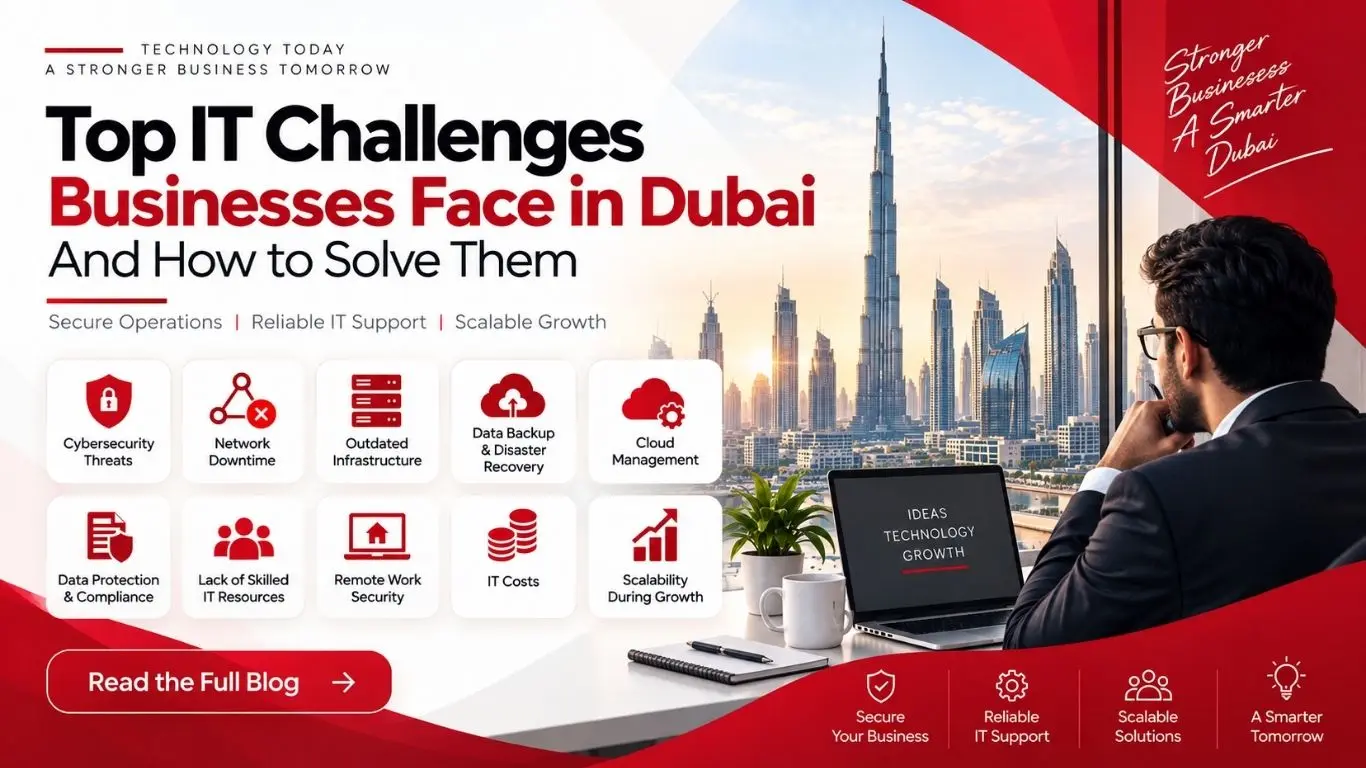
Dubai has become one of the most digitally connected business hubs in the region. Businesses of all sizes now depend on technology for communication, customer management, finance, cloud applications, online services, data storage, employee productivity, and daily operations. As this dependence grows, businesses also face new challenges related to cybersecurity, infrastructure, downtime, data protection, cloud management, and technical support.
For many companies, the problem is not simply having technology. The bigger challenge is making sure that technology remains secure, reliable, scalable, and properly managed.
The IT challenges businesses face in Dubai can vary depending on their industry, company size, infrastructure, and digital requirements. However, several issues are common across SMEs, professional service companies, retail businesses, offices, and growing enterprises.
A proactive IT strategy can help organizations identify these challenges before they become costly disruptions.
Cybersecurity Threats and Increasing Security Risks
Cybersecurity is one of the most important IT challenges for businesses operating in Dubai. Companies increasingly rely on business email, cloud applications, online platforms, remote access, connected devices, and digital databases. Every additional system can introduce another potential security risk.
Businesses may face threats such as phishing, ransomware, malware, credential theft, unauthorized access, business email compromise, and data theft. A successful attack can affect more than just computers. It can disrupt operations, expose confidential information, affect customer trust, and create financial and operational consequences.
Dubai’s Cyber Security Strategy emphasizes resilience, vigilance, constant preparedness, risk consideration, and compliance as digital technologies and cyber risks continue to evolve.
How can businesses improve cybersecurity?
Businesses should adopt a layered security approach rather than depending on one security product. This can include:
Regular cybersecurity assessments can also help businesses understand where their existing environment has weaknesses and which areas should be prioritized.
Network Downtime and Unreliable Connectivity
A stable network is essential for modern businesses. Employees need reliable connectivity to access cloud applications, communicate with customers, use business software, share files, and collaborate with colleagues.
Network downtime can occur because of hardware failures, configuration problems, overloaded infrastructure, ISP issues, outdated networking equipment, or insufficient maintenance.
For a small office, even a short network interruption can prevent employees from accessing essential systems. For businesses with multiple locations, the impact can be even greater.
How can businesses reduce network downtime?
A proactive network management strategy should include regular infrastructure checks, device monitoring, firmware updates, performance reviews, and documented troubleshooting procedures.
Businesses should also identify critical network components and understand what happens if one of them fails. Redundancy and backup connectivity may be appropriate for organizations where uninterrupted access is particularly important.
Professional IT support companies in Dubai can help businesses monitor networks, troubleshoot connectivity issues, maintain equipment, and respond to technical incidents.
Outdated Hardware and IT Infrastructure
Technology changes quickly, but businesses do not always replace their infrastructure at the same pace. Companies may continue using old computers, unsupported operating systems, outdated servers, legacy applications, or aging network devices.
Older systems can create several problems. They may perform poorly, become difficult to support, lack current security updates, or create compatibility issues with newer applications.
Replacing everything immediately is not always practical. Instead, businesses need a structured technology lifecycle strategy.
How can businesses manage outdated infrastructure?
An IT assessment can identify:
Businesses can then prioritize upgrades according to security, business importance, performance, and cost.
This approach allows companies to modernize their infrastructure gradually instead of waiting until a major failure forces an emergency replacement.
Data Backup and Disaster Recovery
Business data is one of an organization’s most valuable digital assets. Customer records, financial information, contracts, employee files, databases, project documents, and operational information may all need to be protected.
However, having a backup does not automatically mean a business is prepared for data loss.
Backups can fail because of incorrect configurations, insufficient storage, inaccessible backup accounts, damaged files, or failure to test restoration.
How can businesses improve backup and recovery?
Businesses should establish a documented backup strategy based on their critical systems and data. Important considerations include:
Businesses should also consider protecting backups from unauthorized access and ransomware.
A disaster recovery plan should identify critical systems, recovery priorities, responsible personnel, and procedures for restoring operations after a major disruption.
Cloud Management and Cloud Security
Cloud services have transformed the way businesses operate. Companies can use cloud-based email, file storage, collaboration tools, accounting systems, CRM platforms, business applications, and infrastructure without maintaining everything on-premises.
However, cloud adoption also introduces new management challenges.
Incorrect permissions, weak authentication, excessive user access, poor configurations, unused resources, and inadequate monitoring can create security and operational problems.
Dubai’s cybersecurity ecosystem includes dedicated controls and standards related to cloud service providers, alongside information-security and IoT standards.
How can businesses manage cloud risks?
Businesses should regularly review cloud accounts, user permissions, administrative access, authentication controls, backup arrangements, and security configurations.
They should also identify unused services and resources that may create unnecessary costs.
Cloud management should not be treated as a one-time setup. As employees, applications, and business requirements change, cloud environments should be reviewed and adjusted accordingly.
Data Protection and Privacy Requirements
Businesses in Dubai handle significant amounts of personal and confidential information. This may include customer details, employee records, contact information, financial data, and business communications.
The UAE’s Federal Decree-Law No. 45 of 2021 on the Protection of Personal Data provides a framework for personal-data protection and establishes obligations concerning the processing, confidentiality, and privacy of personal data.
Businesses therefore need to understand how their data is collected, stored, accessed, transferred, and protected.
How can businesses strengthen data protection?
Organizations can begin by identifying the types of data they hold and determining who actually needs access to it.
Practical measures can include:
Businesses should also consider industry-specific requirements that may apply to their operations.
Lack of Skilled IT Resources
Not every business can maintain a large internal IT department. Smaller companies may have only one IT employee, while some organizations depend on general employees to solve technical issues.
This can become problematic when the company needs specialized knowledge in cybersecurity, networking, cloud infrastructure, servers, Microsoft environments, or disaster recovery.
When one person becomes responsible for every IT issue, there can also be a dependency risk. If that person is unavailable, technical problems may take longer to resolve.
What is the solution?
Businesses can combine internal employees with external IT expertise. Outsourcing selected IT functions can provide access to specialized knowledge without requiring a large in-house technical team.
Managed IT Services Dubai can help businesses with proactive monitoring, maintenance, technical support, infrastructure management, and other ongoing IT requirements.
The right approach depends on the organization’s size, technology environment, internal skills, and business priorities.
Remote and Hybrid Work Security
Remote and hybrid working have changed how employees access business systems. Employees may work from home, from another office, while travelling, or from different locations.
This creates additional considerations around device security, remote access, identity management, Wi-Fi security, file sharing, and business applications.
An employee using an unsecured device or weak password can potentially create a security problem for the organization.
How can businesses secure remote employees?
Businesses should establish clear policies for remote access and company devices.
Useful controls may include:
Access should be based on business requirements rather than giving every user unrestricted access to company systems.
IT Costs and Technology Spending
IT expenses can become difficult to control when businesses purchase technology without a long-term plan.
Costs may come from hardware, software licenses, cloud subscriptions, cybersecurity tools, IT support, maintenance, networking equipment, and emergency repairs.
The issue is not necessarily that businesses spend too much on technology. Sometimes the problem is that technology spending is not properly aligned with business requirements.
How can businesses manage IT costs?
Companies should maintain an inventory of hardware, software, subscriptions, licenses, and cloud resources.
Regular reviews can identify unused software, duplicate services, unnecessary subscriptions, and devices that require replacement.
Businesses should also distinguish between essential IT investments and technology purchases that do not provide meaningful operational value.
A planned IT budget can make technology spending more predictable and reduce the need for emergency purchases.
Legacy Systems and Integration Problems
Many businesses use a combination of old and new technology. A company may have a modern cloud application while still depending on an older accounting system, local database, server, or custom software.
When these systems cannot communicate properly, employees may need to manually transfer information between platforms.
This can lead to duplicate work, inconsistent information, and operational delays.
How can businesses address legacy technology?
Businesses should first identify which legacy systems are genuinely critical and which can be replaced or retired.
An IT assessment can help determine whether systems should be:
The goal should not simply be to adopt the newest technology. The technology environment should support the company’s actual business processes.
Third-Party and Vendor Security
Businesses increasingly depend on external technology providers. Cloud platforms, software vendors, payment providers, IT service providers, consultants, and other third parties may have access to company systems or information.
This creates another layer of security that businesses need to consider.
Dubai’s cybersecurity framework recognizes the importance of collaboration and risk management because cyber risks can extend beyond an individual organization.
How can businesses manage vendor risks?
Before giving a third-party access to systems or sensitive information, businesses should understand what access is required and why.
Companies can review:
IT Scalability During Business Growth
Growth creates new IT requirements.
A company that starts with ten employees may eventually have fifty or one hundred employees, multiple locations, more devices, more cloud applications, and significantly larger amounts of data.
If IT infrastructure does not grow with the business, performance and management problems can appear.
How can businesses build scalable IT infrastructure?
Businesses should consider future requirements when planning networks, servers, cloud services, security systems, user access, and hardware.
A scalable IT environment should make it easier to add users, devices, applications, and locations without redesigning the entire infrastructure every time the business expands.
This is where proper IT planning becomes valuable. Technology should support business growth rather than become a limitation.
Why Proactive IT Support Matters for Dubai Businesses
One of the biggest differences between reactive and proactive IT management is timing.
Reactive IT support usually begins after something has already gone wrong. A server fails, employees lose access, a network stops working, or a security incident occurs—and the business then looks for a solution.
Proactive IT management focuses on identifying potential problems earlier.
Regular monitoring, maintenance, patching, security assessments, backup testing, asset management, and infrastructure reviews can help businesses understand their IT environment before a major incident occurs.
Dubai’s cyber security strategy emphasizes cyber resilience, preparedness, risk consideration, and the continuity and availability of IT systems.
For businesses, this means IT should be treated as an ongoing operational function rather than something that only needs attention when a computer stops working.
How Chipin Corp Supports Businesses with Their IT Challenges
Businesses that do not have sufficient internal IT resources can work with an experienced technology partner to manage their infrastructure and technical requirements.
Chipin Corp provides IT services designed to support businesses with areas such as managed IT support, cybersecurity, network management, system maintenance, technical troubleshooting, and IT infrastructure requirements.
For organizations looking for an IT Company in Dubai, the first step should be understanding the existing technology environment. An IT assessment can help identify infrastructure gaps, security risks, outdated systems, backup weaknesses, and areas where proactive maintenance could improve reliability.
The objective is not simply to add more technology. It is to build an IT environment that is secure, manageable, reliable, and aligned with the business.
A Practical IT Checklist for Dubai Businesses
Businesses can use the following checklist to review their current IT environment:
Cybersecurity: Are endpoints, networks, accounts, and sensitive systems properly protected?
Backup: Are important files and systems backed up regularly, and has recovery actually been tested?
Infrastructure: Are servers, computers, network devices, and software properly maintained?
Access: Do employees have only the access they need?
Cloud: Are cloud services, permissions, subscriptions, and configurations reviewed regularly?
Updates: Are operating systems, applications, firmware, and security patches kept current?
Disaster Recovery: Does the business have a documented plan for restoring critical systems?
Vendor Access: Are third-party accounts and permissions reviewed?
IT Budget: Are technology expenses planned and reviewed rather than handled only when something breaks?
Scalability: Can the current IT infrastructure support the company’s expected growth?
Regularly reviewing these areas can help businesses identify weaknesses before they become significant operational problems.
Conclusion
The IT challenges businesses face in Dubai are becoming increasingly connected to cybersecurity, digital infrastructure, cloud services, data protection, business continuity, and technology management.
Cybersecurity threats, network downtime, outdated infrastructure, backup problems, cloud security, data protection, IT skills shortages, remote-work security, rising technology costs, legacy systems, third-party risks, and business growth can all affect how effectively an organization operates.
The solution is not always to invest in more technology. Businesses need a structured IT strategy that combines reliable infrastructure, proactive maintenance, appropriate security controls, employee awareness, backup and recovery planning, and ongoing technical support.
For growing businesses, proactive IT services in Dubai can help create a more reliable technology environment while allowing internal teams to focus on their core responsibilities.
By regularly reviewing their IT infrastructure and addressing potential risks before they become major problems, Dubai businesses can improve operational reliability, strengthen security, and build an IT foundation that supports long-term growth.
Frequently Asked Questions
About the Author