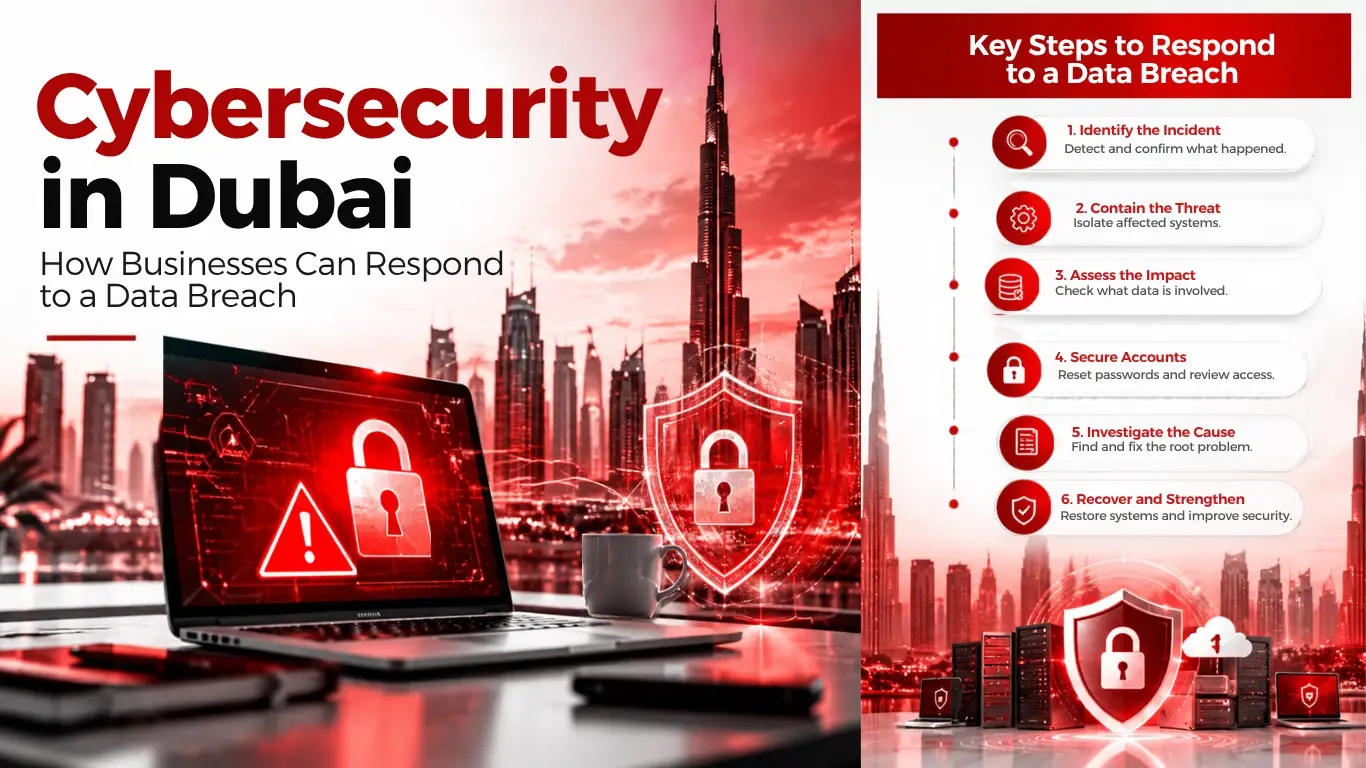
A data breach can become a serious problem for any business. Customer information, employee records, financial details, passwords, business documents, and other sensitive data can be exposed when attackers gain unauthorized access to company systems.
The impact is not limited to lost data. A security incident can interrupt daily operations, affect customer trust, create unexpected costs, and expose weaknesses in a company’s IT environment. This is why businesses need to know what to do when a breach happens and how to reduce the risk of another incident.
For businesses operating in Dubai, Cybersecurity in Dubai should be approached as an ongoing process rather than a one-time activity. Prevention is important, but businesses also need a clear plan for detection, response, recovery, and future protection.
What Is a Data Breach?
A data breach occurs when someone gains unauthorized access to information or systems. This can happen in several ways. An employee may unknowingly open a phishing email, a password may be stolen, outdated software may contain a security weakness, or malware may enter a business device.
A breach can affect a single computer or extend across servers, cloud applications, email accounts, and business networks.
Not every security incident results in confirmed data theft. However, unauthorized access should always be treated seriously until the business understands what happened and what information may have been exposed.
Common Causes of Data Breaches
Understanding how breaches happen can help businesses improve their security strategy.
Phishing and Social Engineering
Attackers often send emails or messages that look legitimate. They may pretend to be a manager, supplier, bank, or service provider and ask employees to click a link, open an attachment, or provide login details.
Because these attacks target people rather than only technology, employee awareness is an important part of security.
Weak or Stolen Passwords
A compromised password can give an attacker direct access to business accounts. Reusing passwords across different services can make the problem even worse.
Multi-factor authentication can provide another layer of protection by requiring an additional verification step.
Outdated Software and Systems
Software that has not been updated may contain known security weaknesses. Attackers can use these weaknesses to enter systems or install malicious software.
Regular patching and system maintenance can help reduce this risk.
Malware and Ransomware
Malware can damage systems, steal information, or provide attackers with unauthorized access. Ransomware can also encrypt important business files and disrupt operations.
This is why endpoint protection, monitoring, backup, and recovery should work together as part of a wider security strategy.
What Should Businesses Do After a Data Breach?
Once a business discovers a possible breach, it should avoid panic and follow a structured response.
Identify What Happened
The first step is to confirm the incident. Look for unusual login activity, unexpected system changes, malware alerts, suspicious emails, or unauthorized access.
The business should record when the incident was discovered and which systems or users may be involved.
It is also important not to delete logs or other information that could help security professionals investigate the incident.
Isolate the Affected Systems
If a device, account, or server appears compromised, appropriate isolation can help prevent the threat from spreading.
For example, an infected endpoint may need to be disconnected from the business network while it is investigated. Compromised user accounts may also need to be secured.
The exact response will depend on the type and severity of the incident.
Review the Affected Data
The next step is to understand what information may have been accessed.
Businesses should review whether the incident involved:
Knowing what was affected helps the business understand the potential impact and decide what needs immediate attention.
Secure Accounts and Access
Compromised passwords should be changed, suspicious sessions should be reviewed, and unnecessary user access should be removed.
Businesses should also review administrator accounts and permissions. Employees should have access only to the systems and information required for their work.
Adding multi-factor authentication to important accounts can provide another layer of protection.
Investigate the Root Cause
Fixing the immediate problem is not enough. Businesses also need to understand how the attacker gained access.
The investigation may reveal a phishing email, stolen credentials, outdated software, poor access controls, malware, or a misconfigured system.
Finding the root cause allows the business to correct the weakness instead of simply restoring the affected system and moving on.
How Cybersecurity in Dubai Can Help Businesses Prepare
A strong security strategy combines several layers of protection. Businesses should not depend on one security product to protect their complete IT environment.
Network security can help control unauthorized traffic, while endpoint protection can monitor computers and servers for suspicious activity. Identity and access controls can limit who can reach sensitive systems, and encryption can help protect important information.
Regular monitoring is also valuable because threats can develop quickly. Early detection gives businesses more time to investigate and contain suspicious activity.
This layered approach is an important part of effective Cybersecurity in Dubai for organizations that rely on connected devices, cloud services, business applications, and remote access.
Protecting Your Business Before a Breach Happens
The best time to improve security is before an incident occurs. Businesses should regularly review their IT environment and identify areas that could create security risks.
Network Security and Firewalls
A properly configured firewall can help control network traffic and reduce unauthorized access. Businesses should regularly review firewall rules and remote access settings.
Intrusion detection and prevention technologies can provide additional protection by identifying suspicious network activity.
Endpoint Detection and Response
Laptops, desktops, and servers are common targets for attackers. Endpoint Detection and Response, or EDR, can continuously monitor devices and help identify unusual behavior.
Chipin provides Acronis-powered EDR solutions that support real-time endpoint monitoring, threat detection, investigation, and automated response.
Email Security
Email remains one of the most common ways attackers target businesses. Phishing, malicious attachments, spam, and ransomware can enter through email.
Email security solutions can scan messages and identify potential threats before they reach users.
Data Encryption
Sensitive information should be protected when it is stored and when it is being transferred. Encryption can help prevent unauthorized individuals from easily reading protected information.
Businesses should identify their most important data and apply suitable protection based on its sensitivity.
Identity and Access Management
Access controls help businesses decide who can access specific systems and information.
Role-based access and multi-factor authentication can reduce unnecessary access and make it harder for attackers to use compromised credentials.
Security Monitoring
Continuous monitoring helps businesses identify suspicious activity as it happens. Chipin’s cybersecurity solutions include 24/7 monitoring and real-time threat detection to support faster response and incident containment.
Why Businesses Need Professional Cybersecurity Services in Dubai
Managing cybersecurity can become complicated as a company grows. Businesses may have multiple offices, remote employees, cloud applications, servers, laptops, and connected devices.
Professional Cybersecurity Services in Dubai can help organizations assess their current environment, identify weaknesses, implement security controls, and provide ongoing monitoring and support.
When selecting a security provider, businesses should look beyond individual security products. A good provider should understand the company’s IT infrastructure, business requirements, security risks, and future growth.
Businesses should also consider whether the provider can support different stages of security, including prevention, detection, response, backup, and recovery.
Choosing the Right Cybersecurity Solutions
Every business has different security requirements. A small office may need strong endpoint protection, secure email, backup, and access controls, while a larger organization may require more advanced monitoring across multiple locations and cloud environments.
Professional Cybersecurity Solutions in Dubai should therefore be selected according to the organization’s infrastructure, number of users, applications, data, and risk level.
A complete approach can combine endpoint protection, network security, identity management, data protection, monitoring, backup, and disaster recovery.
Why a Cybersecurity Audit Is Important
A security audit can help businesses understand whether their existing controls are working effectively. It can identify weaknesses in network configurations, access permissions, endpoint protection, security policies, and other areas.
A Cybersecurity Audit in Dubai can also help businesses create a clearer security roadmap by identifying which risks need immediate attention and which improvements can be planned for the future.
Regular reviews are especially useful when businesses add new systems, move services to the cloud, open new offices, or introduce remote working.
The Role of IT Security Services
Cybersecurity is closely connected to everyday IT management. Systems need to be updated, user accounts need to be managed, devices need monitoring, and backups need to be checked regularly.
Professional IT Security Services in Dubai can help businesses manage these responsibilities while keeping their technology environment secure and reliable.
This ongoing approach can reduce the chances of small technical issues becoming major security incidents.
How Chipin IT Solutions Helps Protect Businesses
Chipin IT Solutions provides cybersecurity and IT solutions for businesses in Dubai and across the UAE. Its cybersecurity services are powered by Acronis and are designed to protect business data, infrastructure, endpoints, and applications from modern threats.
Chipin’s cybersecurity offering includes network security, data encryption, identity and access management, security monitoring, backup and recovery, and security configuration.
Chipin also provides Acronis EDR and XDR solutions. EDR focuses on endpoint-level protection and monitoring, while XDR brings visibility across areas such as endpoints, email, cloud, and networks. This can help businesses identify and respond to threats across different parts of their IT environment.
As an authorized Acronis partner, Chipin can also provide implementation and support for Acronis cyber protection solutions. Its services include deployment, security configuration, monitoring, threat analysis, and ongoing optimization.
This combination of cybersecurity, backup, recovery, and managed support gives businesses a more complete approach to protecting their technology environment.
What Businesses Should Do After Recovery
Recovering from a breach should not be considered the end of the process. Once systems are restored, businesses should review what happened and improve their security practices.
The organization can conduct a security assessment to identify weaknesses that contributed to the incident. User permissions should be reviewed, outdated software should be updated, and security policies should be improved where necessary.
Employees should also receive additional awareness training if the incident involved phishing or social engineering.
Businesses should review their incident response plan as well. The plan should clearly explain who is responsible for investigating an incident, securing systems, communicating internally, managing recovery, and coordinating with relevant experts.
Regular testing can help employees and IT teams respond more confidently if another incident occurs.
Final Thoughts
A data breach can affect much more than a company’s IT systems. It can interrupt business operations, put sensitive information at risk, and affect customer confidence.
The right response starts with identifying the incident, containing the affected systems, understanding what happened, securing accounts, investigating the root cause, and restoring critical operations. After recovery, businesses should focus on fixing the weaknesses that allowed the incident to happen.
Strong cybersecurity in Dubai requires ongoing attention, not a one-time security setup. Businesses need a combination of secure networks, protected endpoints, access controls, monitoring, employee awareness, backup, and recovery planning.
For organizations that want professional support, Chipin IT Solutions provides a combination of cybersecurity and IT services designed to help businesses protect their systems, data, and daily operations.
FAQs
About the Author