Internet Disruption in UAE: Internet Disruptions Across UAE and Region
Internet services in the UAE were disrupted after some cables in the Red Sea were cut, leading to a major Internet Disruption in UAE. This weekend, many people in the Middle East, India, and Pakistan experienced very slow internet speeds. Microsoft acknowledged that these cable issues affected internet access in multiple countries, including its Azure cloud services. The cause of the damage is still unknown. While things seemed to be getting better by Sunday morning, experts warn that the disruptions could last for days or even weeks.
For businesses in Dubai that depend on strong connectivity, teaming up with local IT support providers in Dubai helps maintain operations smoothly, even when unexpected outages occur.
Internet Disruption in UAE: Microsoft and NetBlocks Confirm Service Impact
There are concerns that the cables in the Red Sea might be targeted by Yemen’s Houthi rebels, although they have claimed they didn’t attack them before. It’s worth noting that many cable issues are caused by ships dropping anchors, with around 70% of these incidents happening by accident.
On Saturday night in the UAE, people using internet services from Du and Etisalat reported that their home broadband and mobile connections were much slower than usual, making it hard for many websites and apps to load properly.
By Sunday, the internet services were getting better, but DownDetector.ae still showed that some users were having issues with both companies. On Monday, people continued to complain about slow speeds.
Microsoft Monitoring and Routing Adjustments
Microsoft mentioned early on Sunday that fixing undersea fiber cuts can take a while, so they would keep an eye on things, adjust their systems, and improve routing to lessen the impact on customers in the meantime. The ongoing Internet Disruption in UAE highlights how such undersea cable issues affect millions.
NetBlocks, an organization that monitors online security and digital infrastructure globally, reported that slow internet was being experienced in several countries in the region, including the UAE.
In times like these, businesses frequently look to IT Security Solutions in Dubai to protect their operations and reduce the risk of cyber threats, especially when their connectivity is shaky.
To understand why these issues are so disruptive, it helps to know that more than 97% of the world’s internet traffic runs through submarine communications cables rather than satellites. The scale of this reliance makes the recent Internet Disruption in UAE particularly concerning.
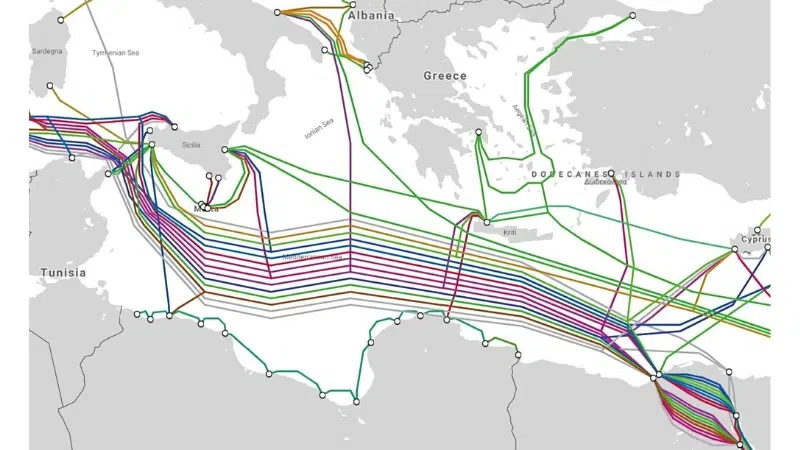
Underseas Cables of Middle East ( Internet Disruption in UAE)

“NetBlocks shared on X that several underwater cable problems in the Red Sea have caused internet issues in several countries, including Pakistan and India. These problems are linked to failures in the SMW4 and IMEWE cable systems close to Jeddah.
In the United Arab Emirates, users on Etisalat and Du networks are also experiencing slow internet speeds and spotty access as technicians try to fix the situation affecting many regions.”
Du’s Customer Support and Updates regarding
Internet Disruption in UAE
Du’s customer support team on social media received a lot of requests for assistance. They replied to several messages from customers whose internet connections had stopped working.
Later, Du shared an update about the issue. On Sunday, they posted on X, saying, “You might notice some slowdowns in our data services because of a cut in an international submarine cable.”
Our tech team is collaborating with global partners to fix the problem. We’ll keep you in the loop with any new updates.
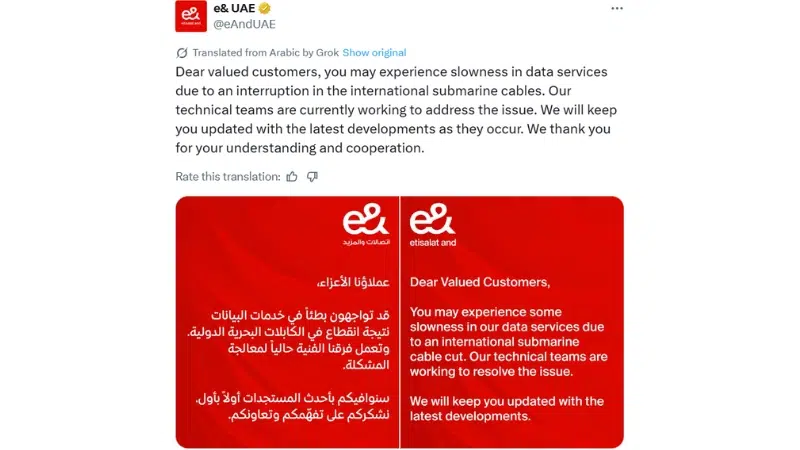
On Sunday, Etisalat communicated via X that they are working to fix the service interruptions. They mentioned, “Dear customers, you might notice slower data services because of a disruption in the international submarine cables.”
They assured everyone that their team is on it and will provide updates as things progress. They also expressed gratitude for your patience and support.
On Saturday, Pakistan Telecommunications Company announced that there had been some cuts to their services. Meanwhile, Saudi Arabia hasn’t recognized the issue yet and hasn’t said anything about it.
Geopolitical Risks in the Red Sea
The Red Sea is an important route for telecommunications, linking Europe with Africa and Asia via Egypt. Fixing the underwater cables in this region can be quite challenging, especially since Yemen’s Houthi forces keep attacking ships there.
Last March, at least three underwater cables were severed, disrupting internet service across Europe, the Middle East, and parts of Asia. An investigation by the US government revealed that the anchor from a ship called Rubymar, which the Houthis had severely damaged, had dragged along the ocean floor and cut those cables.
From November 2023 to December of the previous year, the Houthis launched missile and drone attacks on over 100 ships due to the ongoing Israel-Gaza war. There have been additional attacks this year as well. So far, the Houthis have sunk four ships and caused the deaths of at least eight sailors.
Essential communication services are at risk
Dr. Raed AlHazme, a technology expert who used to be the chief information officer for the Ministry of National Guard Health Affairs in Saudi Arabia, pointed out that the recent internet outages show how dangerous it can be to depend too much on these networks.
“These kinds of problems aren’t new; we’ve seen similar disruptions in the past due to issues like cable damage or cuts,” he noted. “Every time this happens, it reminds us just how delicate our global digital systems are when we rely heavily on outside connections.”
He added, “Many people think that most of the world’s data travels through satellites, but that’s not the case. In reality, satellites handle less than 1% of global internet traffic. The vast majority — over 97% to 99% — comes through undersea cables.”
While traffic was quickly shifted to other cables during the outage, he believes there are important lessons to learn from this incident. He emphasized that depending solely on international infrastructure poses a significant risk, and having control over our own digital systems isn’t just a luxury; it’s crucial for keeping essential services running safely and reliably.
you’re interested in understanding digital resilience in Dubai, you might want to check out this guide on How Fortinet Firewall enhance IT Security. It explains how the rules around security systems are designed to help businesses keep running smoothly.