What Is XDR?

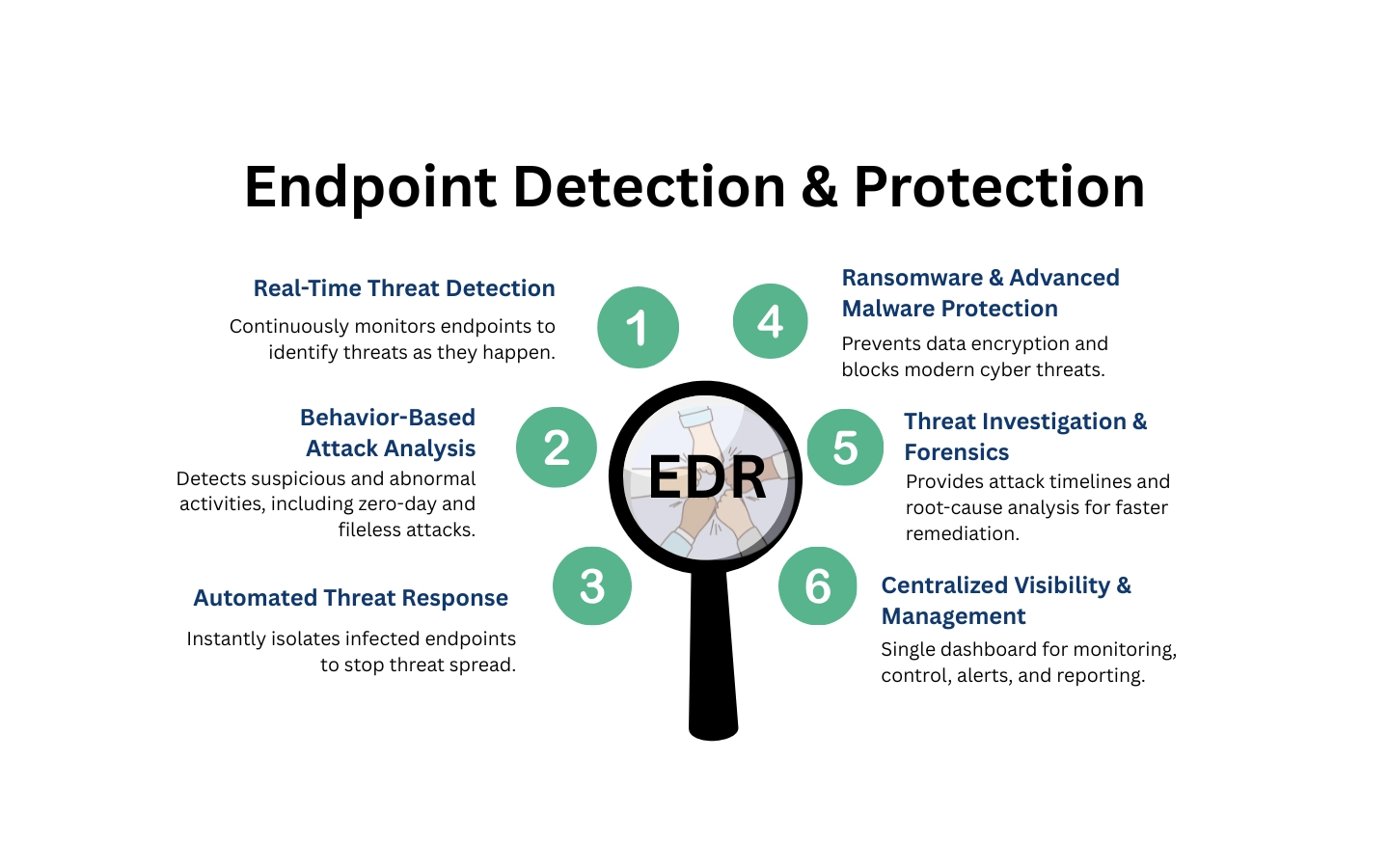
Endpoint Detection Protection 1

Security Layers Covered by XDR

Endpoint

Protects devices by detecting malware, ransomware, suspicious behavior in real time.

Email

Blocks phishing, malicious links, BEC attacks, and infected email attachments effectively.

Network

Detects lateral movement, command-and-control traffic, and hidden network threats.

Servers

Monitors servers for abnormal processes, privilege abuse, and exploitation attempts.

Cloud Workloads

Secures cloud workloads by monitoring identities, configurations, and runtime activity.

Key XDR Capabilities

  • Unified visibility across endpoints, network, email, servers, and cloud
  • AI-driven threat detection with behavioral analytics
  • Cross-layer data correlation to expose full attack chains
  • Automated incident response and rapid remediation
  • Centralized dashboard for investigation and threat hunting
    Seamless
  • Integration with existing security tools and SOC workflows

Key XDR Benefits

  • Faster threat detection and response, reducing Mean Time to Respond
  • Reduced alert fatigue by correlating alerts into meaningful incidents
  • Complete attack context instead of isolated security events
  • Improved security operations efficiency through automation
  • Stronger protection against advanced and zero-day threats
  • Scalable security for on-premises, hybrid, and cloud environments
Why is XDR Important for Modern Cybersecurity?​

Why is XDR Important for Modern Cybersecurity?

Extended Detection and Response (XDR) delivers all-in-one Solutions cybersecurity protection that goes far beyond traditional endpoint security. It simplifies deployment, automates updates, and uses advanced analytics to reduce false alerts—allowing security teams to focus on real threats instead of alert fatigue. This results in faster, more accurate threat detection across the entire IT environment.

Unlike traditional SIEM tools, XDR identifies threats that are often missed by correlating data from endpoints, networks, cloud platforms, and email systems. This unified visibility helps organizations clearly understand attack paths and assess the real impact on systems and users.

XDR also improves how security teams operate by enabling real-time monitoring, faster incident response, and easier cloud security management. Instead of protecting isolated systems, XDR secures the entire attack surface.

At Chipin Corp, we help businesses implement and manage XDR solutions that strengthen security posture, streamline operations, and ensure rapid response to modern cyber threats.

How XDR Works

Extended Detection and Response (XDR) follows a structured, intelligence-driven process to detect, investigate, and respond to cyber threats across the entire IT ecosystem. By integrating multiple security layers into a single, centralized platform, XDR removes visibility gaps, reduces alert noise, and enables security teams to act with speed and precision. This unified approach helps organizations stay ahead of modern, sophisticated attacks.

  • Data Collection – XDR continuously gathers telemetry from endpoints, email systems, networks, servers, identities, and cloud environments, ensuring complete visibility across on-premises and cloud infrastructures.
  • Normalization & Correlation – Collected data is standardized and intelligently correlated to connect related events, transforming scattered alerts into a single, high-confidence incident with full attack context.
  • Advanced Analytics – Using AI, machine learning, and behavioral analysis, XDR identifies advanced, zero-day, and stealthy threats while minimizing false positives.
  • Automated Response – XDR initiates rapid, automated actions such as isolating compromised devices, blocking malicious users, and stopping harmful processes to limit impact.
  • Continuous Improvement – Insights from incidents continuously refine detection models and response strategies, strengthening security over time.

Key Use Cases of XDR Security

  • Ransomware Detection and Containment
    Identifies ransomware early and automatically isolates infected systems to prevent spread.
  • Advanced Persistent Threat (APT) Detection
    Detects stealthy, long-term attacks by correlating activity across multiple security layers.
  • Phishing & Business Email Compromise Prevention
    Blocks phishing emails, malicious links, and credential-theft attempts before user interaction.
  • Insider Threat Detection
    Monitors user behavior to identify unauthorized access, data misuse, or compromised accounts.
  • Cloud Security Monitoring and Response
    Protects cloud workloads by detecting misconfigurations and suspicious runtime activity.
  • SOC Modernization and Tool Consolidation
    Centralizes detection and response, reducing tool sprawl and improving SOC efficiency.
Key Use Cases of XDR Security

How to Choose the Best XDR Solution

Selecting the right Extended Detection and Response (XDR) platform is critical to building a strong, future-ready advanced cybersecurity strategy. With multiple vendors offering XDR capabilities, organizations should evaluate solutions based on both technical depth and operational value.

First, ensure the XDR platform provides broad coverage across all critical security layers, including endpoints, email, networks, servers, cloud workloads, and identities. True XDR should deliver unified visibility rather than isolated protection.

Next, look for strong native detection and response capabilities. A high-quality XDR solution should detect advanced threats early and support rapid, automated containment to minimize business impact.

AI-driven analytics and automation are essential for identifying complex, multi-stage attacks and reducing alert fatigue. Machine learning and behavioral analysis help prioritize real threats over false positives.

The solution should also offer easy integration with existing security tools, including SIEM, SOAR, firewalls, and identity platforms, to avoid disrupting current workflows.

Additionally, choose a platform with centralized visibility and intuitive dashboards that simplify investigation and threat hunting.

Finally, consider scalability, along with the vendor’ssupport expertise and managed service options, to ensure long-term protection as your business grows.

Frequently Asked Questions

Q: Is XDR better than EDR?

Yes. XDR extends EDR by covering multiple security layers, not just endpoints.

Q: Does XDR replace SIEM?

XDR can complement or reduce dependency on SIEM by providing faster, more contextual detection and response.

Q: Is XDR suitable for small businesses?

Yes. XDR is scalable and helps small teams manage security efficiently with automation.

Q: Can XDR work with existing security tools?

Yes. Most XDR solutions integrate with third-party tools and security platforms.